
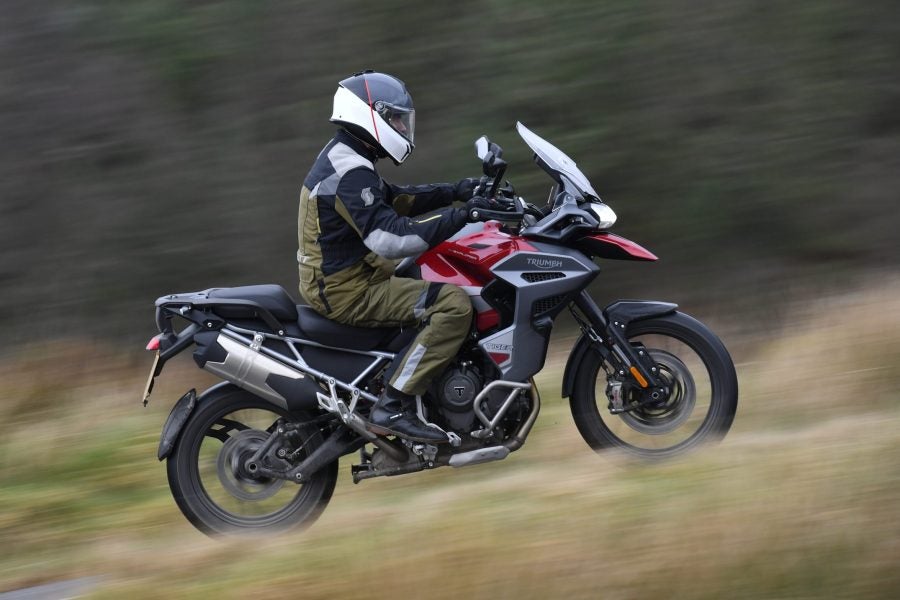
Photos: Triumph
Tiger by the Tail
Once upon a time, long ago, my ancestors left the damp, cold rains of Scotland for the endless opportunity of the US. And then, in a perverse twist, my people decided the weather in the US wasn’t miserable enough, so they came north to the snow and damp of Canada. It’s a move that’s always struck me as nonsensical. That is until I landed in Glasgow for the launch of Triumph’s rejigged Tiger 1200 range and began to bump into Glaswegians.
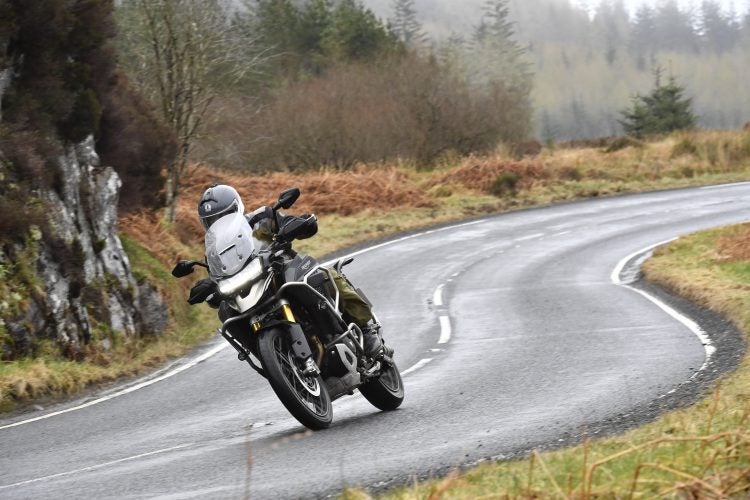
Scotland in spring. Heated grips and good riding kit is key during the day. Single-malt makes the evenings sail past.
Having arrived in the city center after taking a bus from the airport, I jumped in a cab to take me to my hotel. It’s then I noticed the “cash only” sign on the plexiglass barrier. “No credit cards?” I asked. The driver looked at me in horror. “Why no,” he said, “we’d have to pay taxes then, wouldn’t we?” Out of the cab I get. After a long (and ultimately fruitless) search in which locals confidently gave me conflicting information as to the location of an ATM, I gave up and walked 14 blocks to the hotel in unrelenting rain. Only to find that the hotel was locked. In the middle of the afternoon. I found a bar. And then, two hours later, I lost the hotel.
Oddly, I’m OK with rain. It’s not snow, after all. And something else, too. Someone once asked me the best way to judge the merits of a motorcycle. Such a straightforward yet complex question. I pruned it down to this advice: ride a bike in the rain on narrow roads and stuff in as many U-turns as you can. Why? The very thing that drew many of us to motorcycling—the delectable characteristic that they lean to corner—is also the very thing that causes us, as riders, to tense up. In the rain this is exacerbated, of course. But if a bike can put you at ease when the weather’s dodgy, then it’s well on the way to proving its worth. And as for U-turns—every press launch has dozens of them as we’re fired and re-fired past the cameras—that’s where you learn about a bike’s fueling, shifting, maneuverability and if it’s plagued by unbecoming issues like excessive driveline snatch. In other words, conditions were ideal as I rode out of our Scottish hotel in far less than ideal conditions.
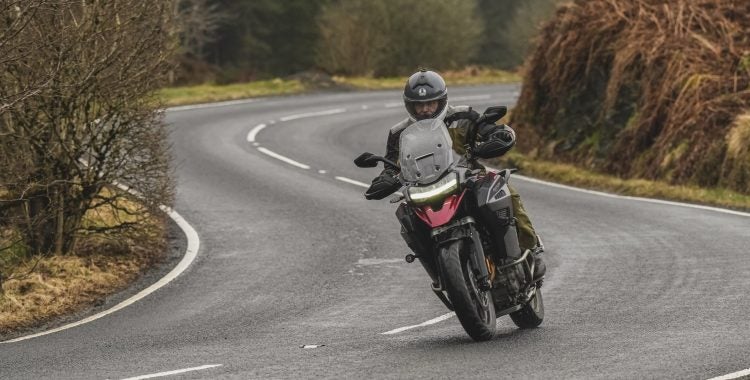
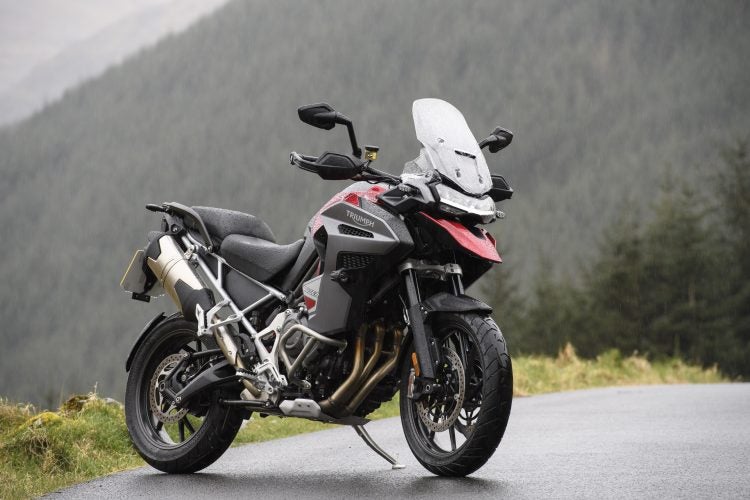
A nineteen-inch front wheel makes this the GT Explorer, but few would argue against the assertion that the 21-incher on the Rally Explorer makes for a better stance. Roadholding on any iteration of the Tiger is sure-footed, even in the wet.
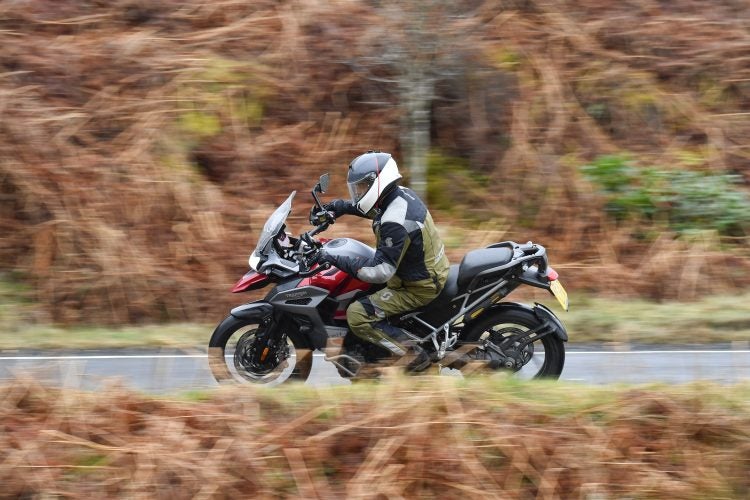
Riding into the chill and dank of a Scottish morning, I turned the heated handgrips to a temperature suitable for grilling roadkill (ditto for the heated seat) and set about getting to terms with the re-jigged for ’24 Triumph Tiger 1200. Although the big Triumph is only two years into its life and has proven a strong seller, with 14,000 shuffled out the factory doors in the past 24 months, it’s telling that the bike again fell under the knife. I use the word telling not to imply that there was anything wrong with the old bike, but rather to illustrate how important the large-displacement ADV market is to manufacturers. Twenty or 30 years ago, 24-month refreshment cycles were strictly reserved for the hot sellers of the age—600 cc and open-class sportbikes. The parallel can be directly drawn that today’s 800- and 1,200 cc (or thereabouts) ADV bikes are the meat of many manufacturers’ lineups.
Right from the get-go, it’s obvious the Tiger’s 1,160 cc triple (Triumph claim 147 horsepower and 95 lb-ft of torque) is a charmer. Employing what Triumph refers to as a “T-plane” crankshaft configuration, it eschews the perfectly sensible notion that crank journals should be placed at evenly-spaced, 120-degree intervals. Instead, the crank journals are at 0, 90, and 180 degrees. Why this approach? Smooth, even power—as is the case with the 120-degree crank—isn’t ideal for riding off road as there’s no “break” in the power pulses for the tire to find traction. (Volumes have been written on this subject, with everyone from MotoGP engineers to back-shed flat-track builders experimenting with alternative firing orders to best aid traction.) The problem with Triumph’s original interpretation of this concept was that vibration was unduly increased. For 2024, Triumph re-addressed the concept, altering crank and balance-shaft weights with the goal of keeping the engine funky while getting rid of the vibes that caused the funk. And it worked. The engine has a raspy, visceral nature, a stirring (if subdued) exhaust note, and enough induction noise so you know you’re not riding a lawnmower.
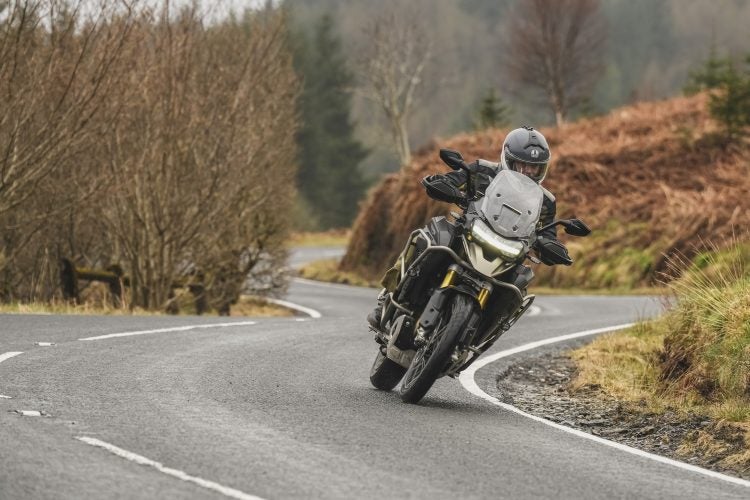
Back to those U-turns and wet roads. The Triumph is utterly confidence inspiring at speed. Relatively narrow tires on both iterations of the bike (more on this in a moment) make it easy to sense the degree of traction available. As for U-turns, they reveal the merits and limitations of the Tiger. Increased rotating mass in the engine make the new bike less prone to low-rev stalling than the outgoing model, but a high center of gravity and low-speed fueling a touch on the touchy side make it necessary to have a disciplined and practiced throttle hand.
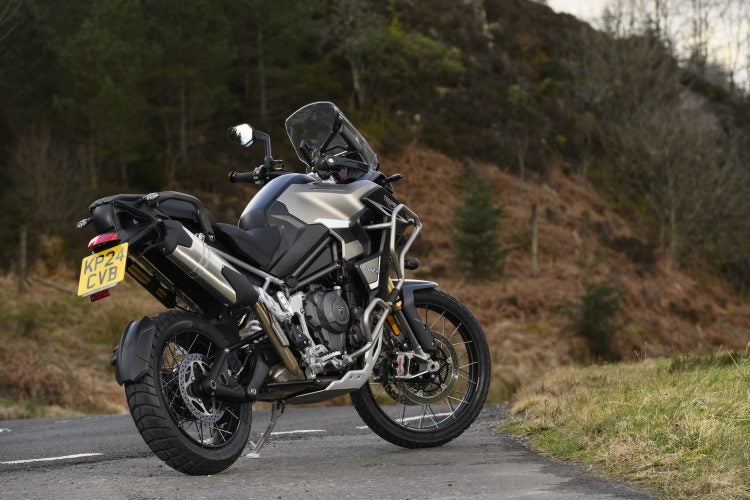
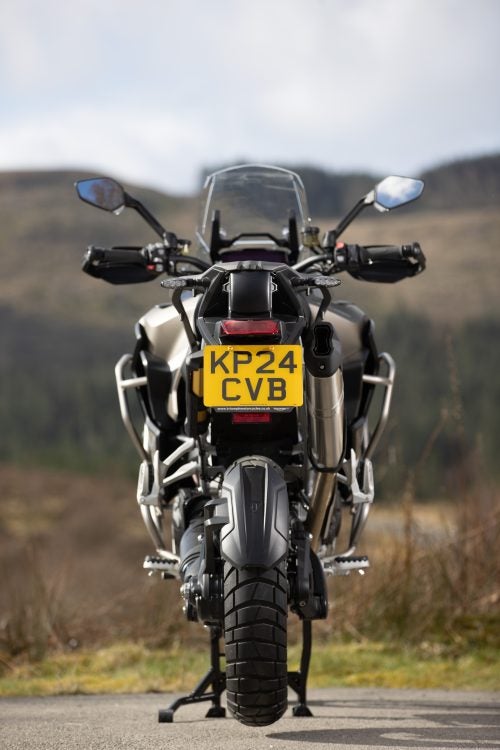
Silencer tucks in neatly, crash bars will be helpful off road, and fit and finish are exemplary. Heated seat is the bomb.
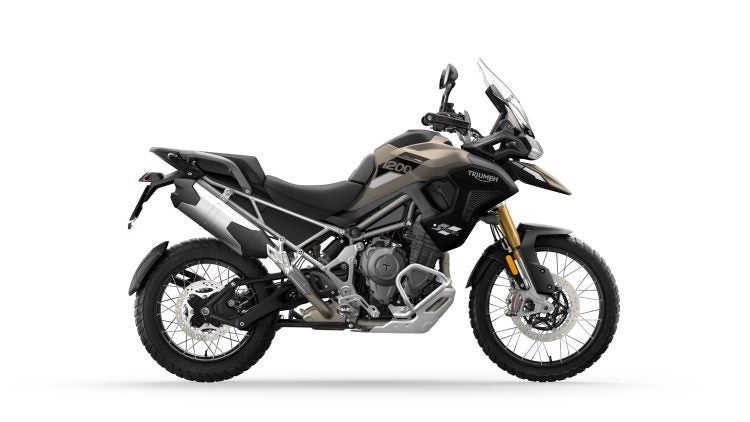
As has become the standard with upwardly mobile ADV bikes, the Tiger 1200 comes in four variants. The Tiger GT Pro has a street-biased cast-aluminum 19-inch front/18-inch rear wheel combination, and the Tiger Rally Pro a spoked 21/18-wheel combo suggestive of dirt prowess. Fuel capacity on both is 5.3 gallons. Oddly, those two won’t be coming to the US in 2024, though they will in 2025. The two machines coming to the US are the Tiger GT Explorer and the Tiger Rally Explorer. They are, essentially, the same as the GT Pro and the Rally Pro but with fuel capacity boosted to 7.9 gallons. Got all that?
Restraint was the order of the day given the cool and wet roads, but the GT Explorer ($23,795) with its 19/18-wheel combo, didn’t feel appreciably different than the Tiger Rally Explorer ($24,895) with its 21/18-wheel combo. However, had the roads been dry, temperatures more reasonable, and the pace far quicker—in other words, had we been in southern Spain—the GT’s 19-inch front wheel would surely have lent the bike a more planted feel on tarmac than the Rally’s 21-incher.
Here’s the part of the review where we bump into reality. This is a tall bike with a high center of gravity. The GT Explorer’s seat is two-position adjustable for 33.5 or 34.5 inches, while the Rally Explorer is a loftier 34.4 or 35.2 inches. Truthfully, the GT Explorer is the bike that suits more people than the Rally Explorer, as its lower seat and wheel combo make it a de-facto sport-touring motorcycle—which is how most of these big bikes will be used. More truth: I suspect more will buy the Rally Explorer because that 21-inch front wheel just looks better. If I had to choose between the two, that’s what I’d do.
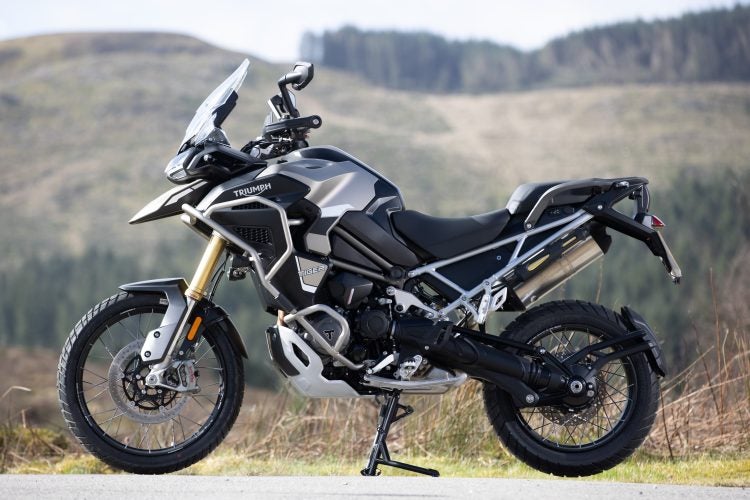
How to justify an expensive new motorcycle: shaft drive saves on chain lube. Revised seat is flatter than on old model.
Making life easier—so long as you plan your foot dabs onto the ground in advance—is Triumph’s inclusion of active preload reduction. Hold down a button on the right switchblock as you come to a stop and the Tiger squats a little less than an inch by reducing the rear shock’s preload. (The bike rises back to normal height as soon as you pass 20 mph for more than 10 seconds on the way back up to speed.) The only awkward aspect to the system is that braking and holding the button requires a certain dexterity—a motorcyclist’s right hand is busy enough.
Our launch didn’t include off-road riding, which, given the conditions and the fact that Triumph claims 578 pounds for a fully fueled Rally Explorer, is a blessing (the GT Explorer claims 564 pounds). Unless you’re a rider with exceptional skills and/or your bank account can withstand dumping a $25,000 motorcycle, these two bikes—along with big BMWs and KTMs—belong to a sub-genre I call “crumbling infrastructure motorcycles.” And the Tiger 1200 absolutely gobbles up bad roads. Of course saying to your mates you bought a motorcycle because of potholes in the neighborhood isn’t enough to warrant a $25,000 motorcycle. What the big ADV bike promises is that tomorrow morning, right after coffee, you could, so long as you find someone to raise the kids and pay the mortgage, strike out for the Horn of Africa. Or Starbucks. Whichever is closer.
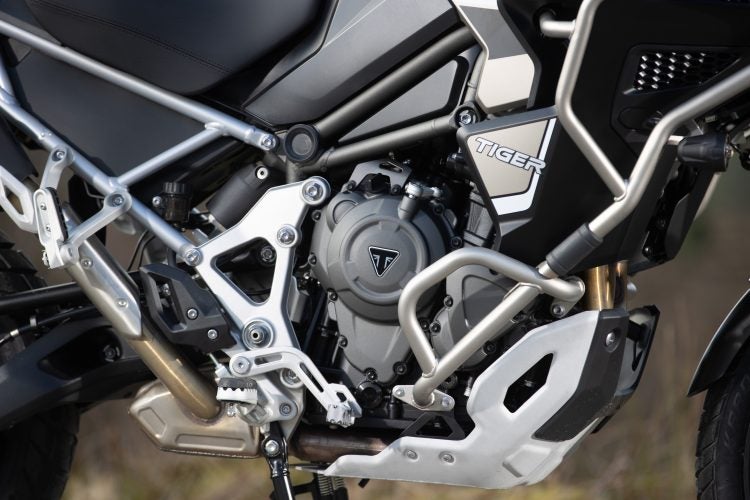
Tiger engine is a big pussy. Three-banger has character to spare and the gear-whine from old triples is gone. Mercifully.
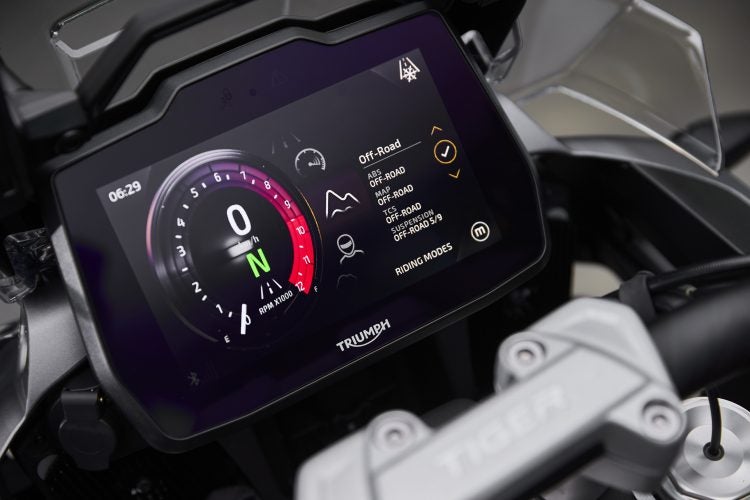
It’s become fashionable for riders to bemoan the inclusion of sophisticated technology on modern motorcycles. And as much as I understand (in theory, if not in practice) the appeal of kickstarters, carburetors, and drum brakes, some of today’s tech can transform the riding experience. Chief among them is semi-active suspension that automatically tweaks suspension compliance to suit load and ride mode. Hammering along a highway for mile-after-mile of expansion joints? Hit the button for a 1970s Cadillac experience (minus the wallow). Exit the highway to a twisty mountain road of fresh tarmac? Press MotoGP mode and let the computer do the rest. A full complement of ride modes are available (sport, road, rain, etc.) and the intrepid among you will be glad to know front and rear ABS can be turned off on the Rally Explorer in off-road pro mode so you can crash harder and more dramatically without technology to save your ass. Antilock braking, naturally, is standard. As is traction control and blind spot detection—I can get behind the latter—have you ever forgotten to make a shoulder check? I know I have. Just last week.
Triumph is an anomaly as a brand. Exotic yet workmanlike at the same time. In that way Triumphs are a little like Moto Guzzi but without the capital Q quirkiness. Case in point: Triumph engineers told us the bike is without adaptive cruise control because customers told them it’s not worth the cost. Triumph is the most Japanese of European manufacturers in that they don’t double-down on the niche market but rather aim at the broader market. The Tiger 1200 is proof of the approach. Whereas Ducati seek to own the face-meltingly-fast ADV segment with its Multistrada while KTM and BMW battle it out for big-bike off-road supremacy, the Tiger is content to be neither. Truthfully, the Tiger has more in common with Suzuki’s cuddly V-Strom than any other big ADV bike.
Big, comfortable, flexibly-powered and utterly free of the quirks that can become aggravating over time, the Tiger 1200 is a bike seemingly without vices. Neither Scotland—nor the Scottish—can do a thing to ruin the fun, even though they gave it a damn good shot.
(Check out the photos below.)