
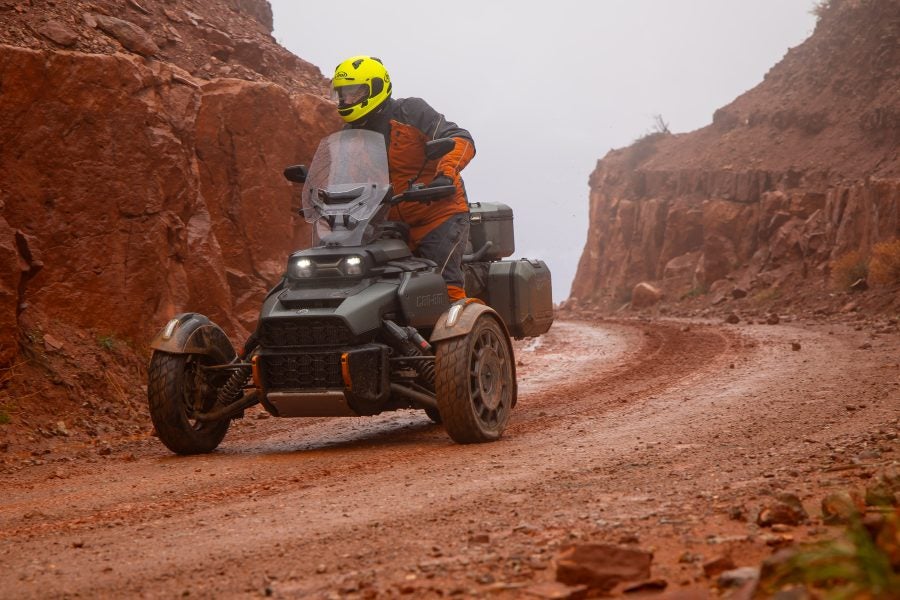
There I was, in Prescott, Arizona, 5,300 feet above sea level on a gloomy, rainy day, about to take off on an oddball-looking three-wheeler with unfamiliar controls. I didn’t know what to expect from the Can-Am Canyon, but over the day’s ride, I was assured I was going to find out what it’s all about. A ride that mixed highways, byways and unpaved roads would see to that… and the weather was going to drive that lesson home.
Tech talk
First, some background. The Canyon debuted in three sub-models last August (see initial write-up here). There’s the standard Canyon, the up-spec’d Canyon XT model and the full-lux Canyon Redrock. At their core, all three machines are based on the same engine—the three-cylinder Rotax Ace, also used elsewhere in Can-Am’s three-wheeler lineup, and even in other powersports products in various configurations. Here, it has 1330 cc capacity, putting out 115 horsepower and 96 pound-feet of torque. The engine is mated to a six-speed semi-auto gearbox; the rider uses a paddle shifter on the right-hand grip for upshifts. The Canyon downshifts automatically, or you can override the system and trigger the downshifts through the paddle shifter. This is a rear-wheel-drive vehicle, with a drive belt instead of a chain or shaft.
The Canyon lineup comes with Sport, All-Road, Rally, and Normal riding modes, to help you suit power delivery to your riding conditions (you can also use a user-defined mode on the Redrock). The Vehicle Stability System helps manage the braking system and TC to help you keep everything more-or-less in-line and headed where you’re steering.
-
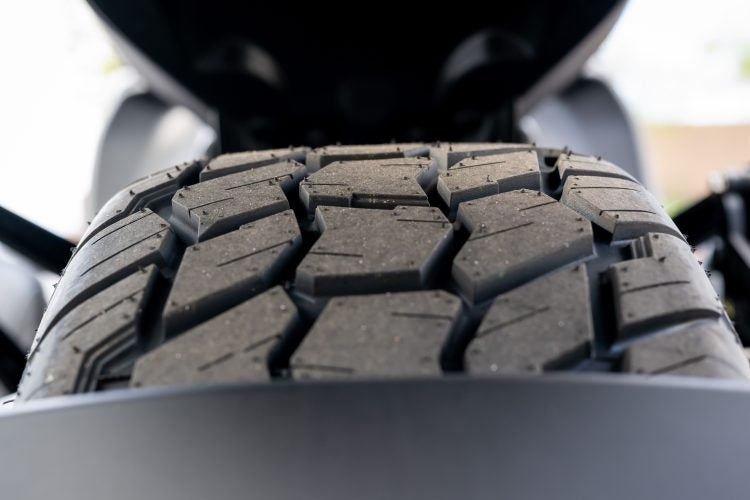
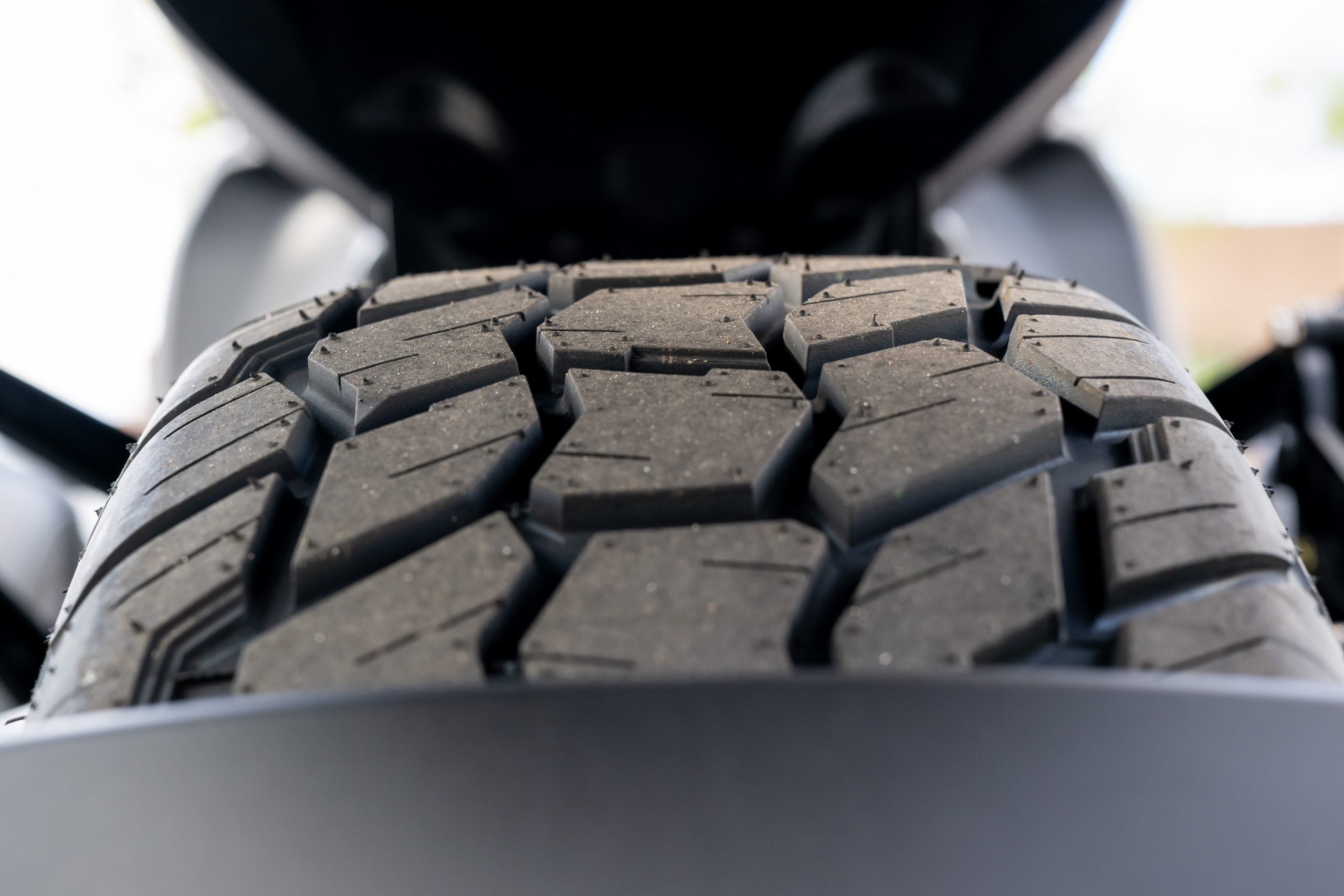
- That’s not your standard dual sport tread!
-
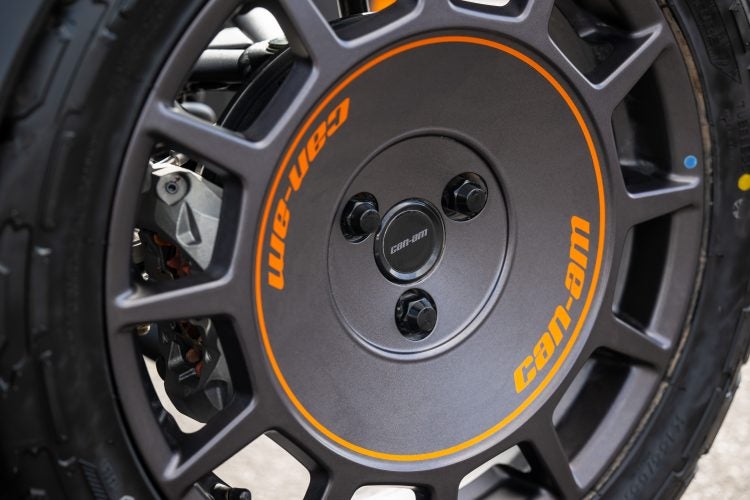
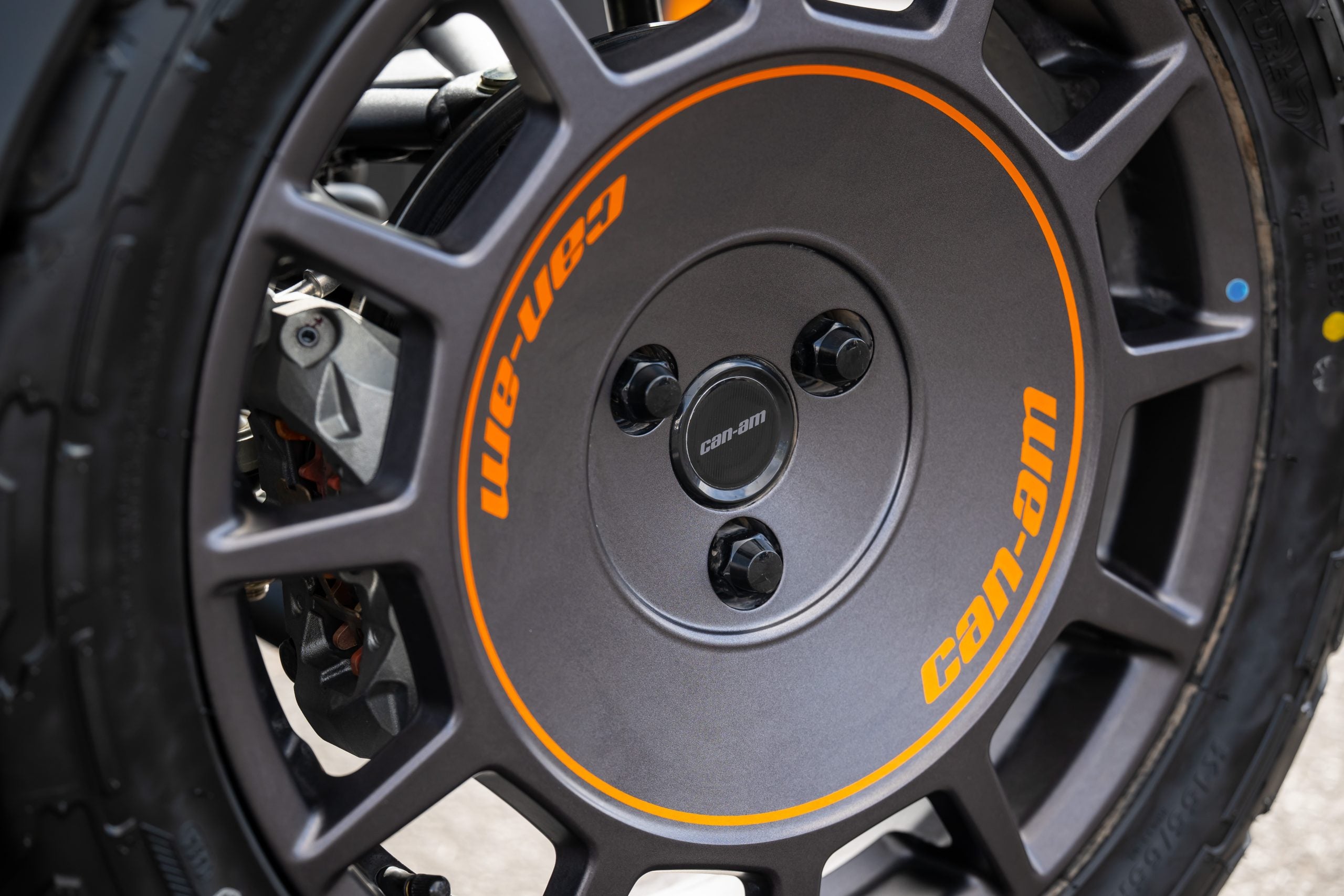
- Cast rims might take a beating on a rocky road…
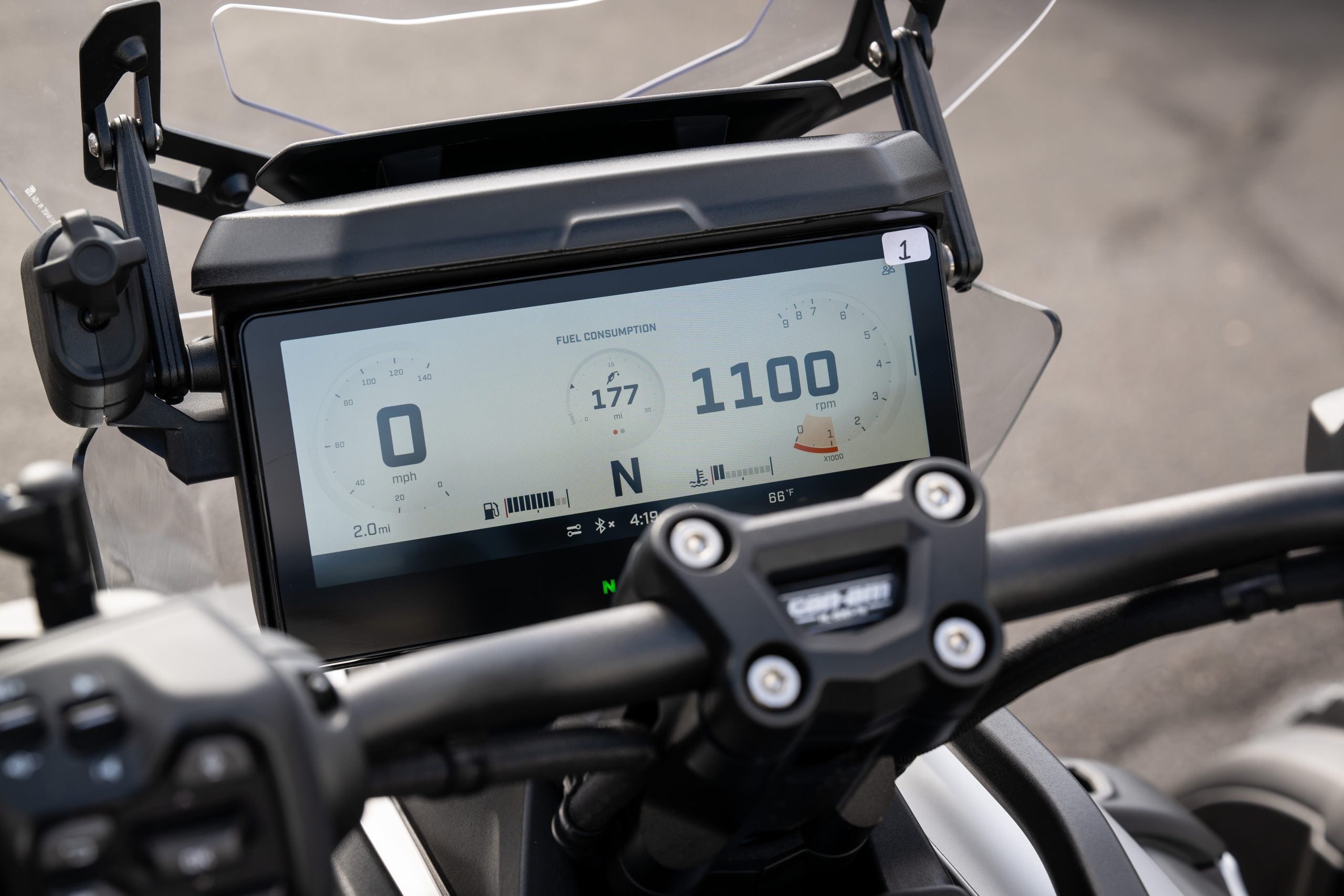
The electronics are managed through an array of switches and buttons that initially look as confusing as the controls of a B52 bomber. However, by the end of my morning on the bike… errrrr… trike, the controls were mostly intuitive. It helped that the 10.25-inch TFT screen let you know what was going on with straightforward language, with no weird icons or acronyms to confuse the rider. The screen is Apple CarPlay-compatible, but does not work with Android Auto yet.
Aside from those boxes of controls, the handlebars look naked; there’s no clutch lever and no brake lever. Front and rear braking is combined, and managed through a foot pedal. There are 270 mm disc brakes up front, with a fixed four-piston Brembo caliper. In back there is a single 270 mm disc with single-piston floating caliper and integrated parking brake, which is electrically actuated.And there are three wheels, not two, with Can-Am’s usual two-in-front, one-in-back arrangement. The wheels are cast aluminum, with XPS Adventure tires standard front and rear, specifically made for this machine. The front tire size is K155/65 R16 72H. Rear tire size is K225/50 R15 84H. Ground clearance is 6.3 inches.
-
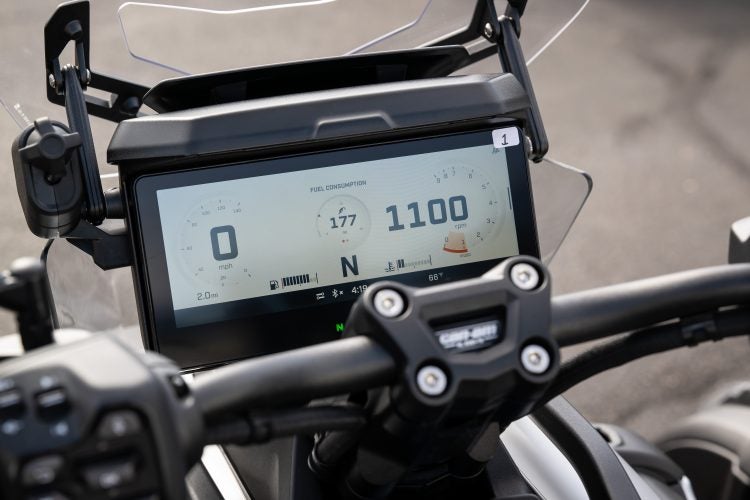
- The wide screen makes it easy to keep on top of the electro-features.
-
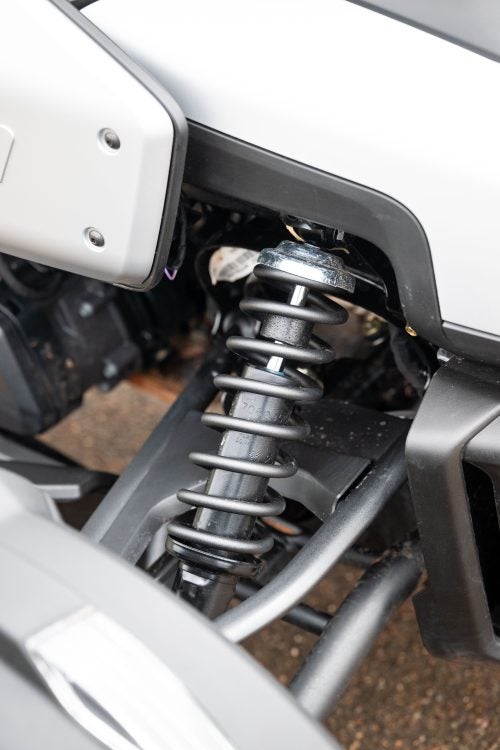
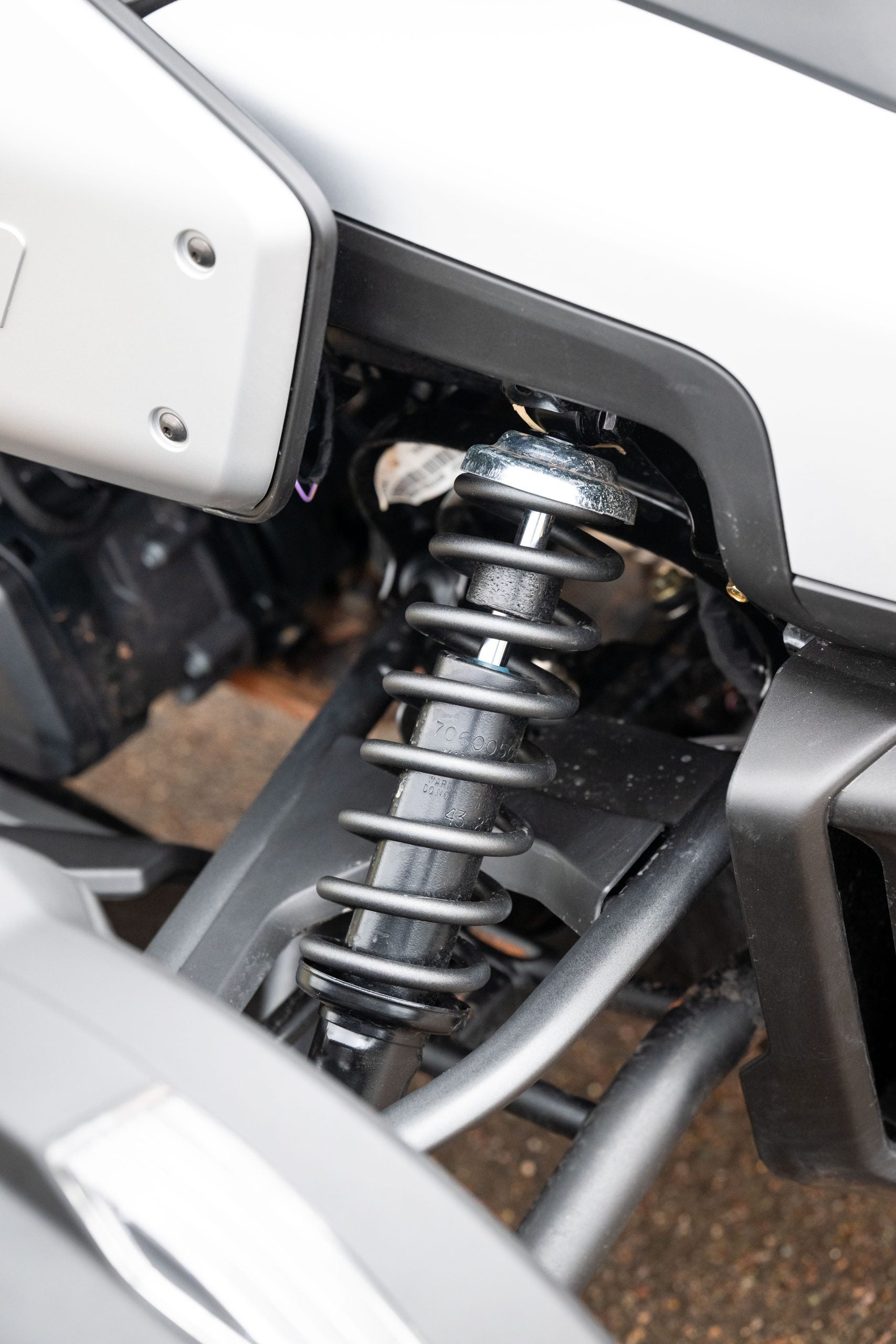
- The suspension is a lot more complicated than your motorcycle, but nothing you can’t tinker with if you’re familiar with ATVs.
Seat height is a very manageable 33.2 inches, and the base model Canyon weighs 996 pounds dry; the luggage package included on the XT and Redrock models pushes weight up to 1036 pounds. The top box and side cases combine for 120 liters of space
Aside from the luggage package, the other main difference between the base model, the XT and the Redrock is the suspension. All models have double A-arms up front with Sachs shocks and a swingarm setup in rear. The base model has a basic Sachs shock in rear; the XT has a self-leveling rear suspension from Sachs for a better-performing ride. The Redrock has the full-lux semi-active KYB Smart-Shox (purpose-built for this vehicle) that auto-adjust to suit your riding conditions. On the Redrock, you can choose from pre-set suspension performance profiles (whether you want comfort or sporty performance).
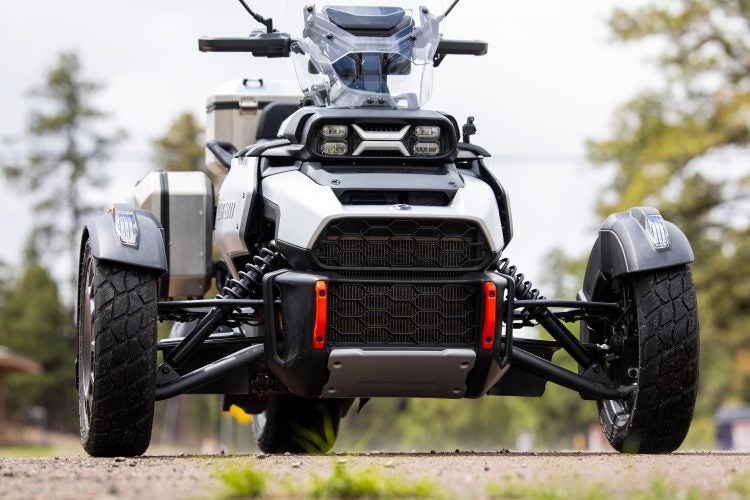
No, you can’t mount a winch there. I asked.
The Redrock and XT also have heated grips for passenger and pilot, and the Redrock has a backup camera. All of the upgraded features of the Redrock or XT can be added to the base model as well, along with more than 20 accessories that attach via Can-Am’s proprietary LinQ system, as also used on their ATVs and watercraft and more. Some of the accessories from Can-Am’s other powersports vehicles are drop-in fit to the Canyon, which is handy if you want, say, a cooler for the backcountry…
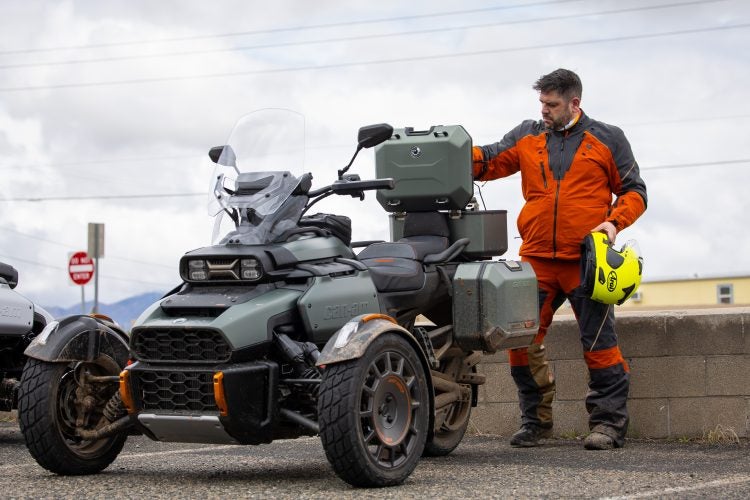
Our intrepid editor loads an extra sweater in his topbox as he notes the foul weather ahead.
On the pavement
Enough jabber about specs, how does the thing ride? Noting the rain, I made sure to grab a Redrock model, with heated grips (but alas, no heated seat for the rider, only for the passenger, since this one hadn’t been fully tricked out). Note that this was my first time ever aboard a Can-Am three-wheeler, and all I’d ever heard from my moto-journo friends who had ridden them before was:
- “The vehicle’s stability system steered me into a lake”
- “Those things want to drive off the road and the only thing keeping them on there is constant interference from the electronics”
- “The three-wheeled design means they hit every bump and pothole, because you can’t steer around them all”
I am happy to report that I did not run into a lake, and that the electronics are much-improved over earlier versions. As for the challenges of riding a three-wheels-wide machine, well, that’s part of the game.
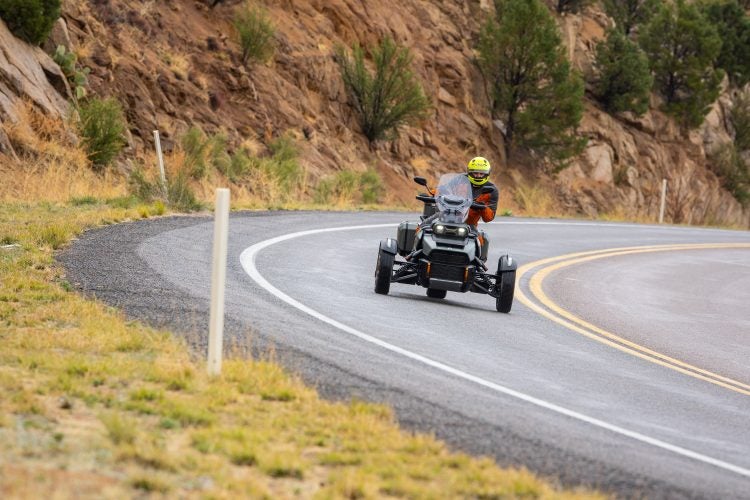
Hanging off the side doesn’t really do much to help the Canyon’s handling. It’s heavy and planted and the electronics keep you going where the handlebars are pointed.
Heading out the parking lot and into the town, and then into the nearby mountains, I was pleased to find that while the Canyon certainly felt different from a motorcycle, it was still quite fun. You’re steering this ride, not counter-steering, and at higher speeds on the road, you’re using a lot of muscle compared to a motorcycle; shifting your weight around does little to change the balance of the machine, only of your own body’s c-of-g. Acceleration is fun, certainly not as fast as a motorcycle but then again, you’re not riding a motorcycle, so stop whining and enjoy the ride for what it is.
Want to take things from safe to sporty? The Can-Am allows you to change electro-settings on the fly, unlike the nanny-like worrywarts that design other vehicles. As for the paddle shifter and foot-pedal-only braking system, Can-Am staffers warned us we’d be stabbing for non-existent brake and clutch levers, but I honestly didn’t find this too bad. Over a few days of riding, I think you’d subconsciously deal with this quirk as easily as those riders who own both left-hand-shift and right-hand-shift motorcycles.
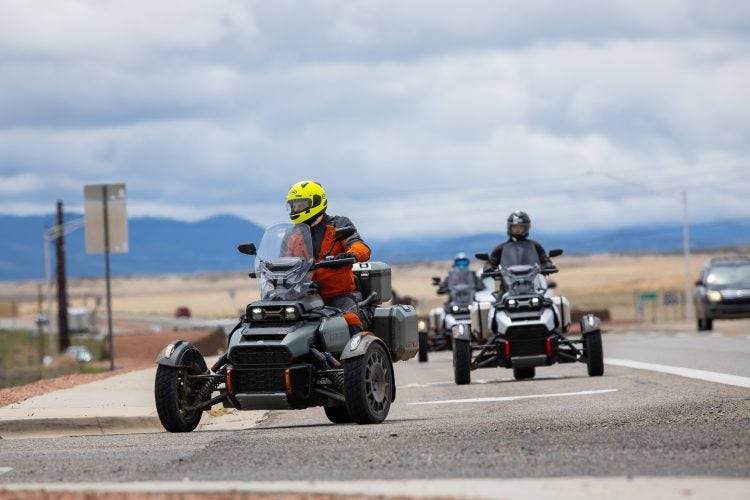
Note that you can’t really pull up alongside a friend at a traffic light to chat, when you’re riding this machine. They’re just too wide.
When it comes time to stop, the binders slow these things down in a hurry. I didn’t get much opportunity to practice emergency stops on pavement, but at one point in the afternoon I made sure I had lots of space around me on the road and smashed the gear pedal down a few times. Again, you might be able to stop a motorcycle a bit more quickly, but that would be because the Can-Am is heavier, not because it has poor brakes. You can scrub speed quite quickly.
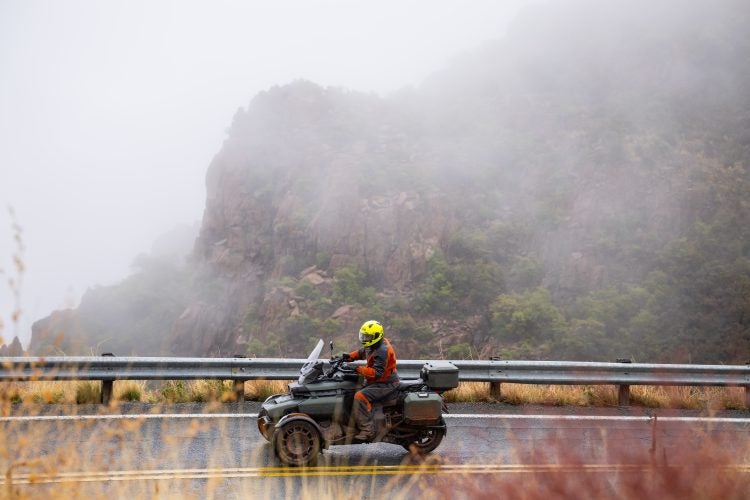
All that bodywork (including an adjustable windshield) keeps you fairly comfortable, even in foul weather.
I wondered if, at the end of the day, the Canyon’s unfamiliar steering system would leave me with stiff back muscles or other discomfort. This didn’t happen; in fact, the adjustable windshield and all the other bodywork did a pretty good job of keeping the weather off me all day, and the seat was very comfortable, so I ended the ride feeling less beat than I had when I’d spent the previous weekend on my Super Tenere.
Off the pavement
Let’s get one thing straight here: The Can-Am Canyon is not an off-road vehicle. It is intended, as the staffers say, for “all roads.” This is partly because, remember, new-production three-wheeled off-road vehicles have been more-or-less illegal since the Honda ATC and Yamaha Trimoto and all the rest of those lovely contraptions were banned from sale in North America.
It is also wise to remember that this is a heavy, wide machine, and that means that even if it was legal, it would not be suitable for your OHV park, and you’d start breaking things quickly if you headed down single track. Even a lot of two-track would be challenging. A BDR would be very difficult, although some keeners might make it work.
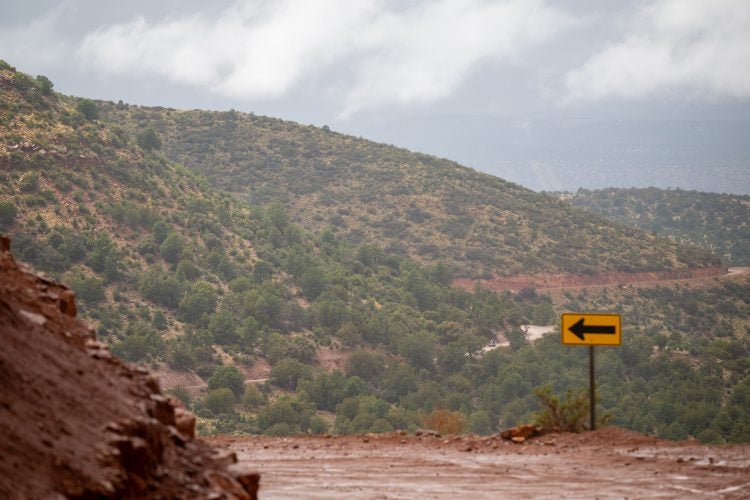
This cliffside road would have been downright dangerous for many riders on two wheels.
One of the first questions I asked at the press intro was whether you can mount a winch to the front of the Canyon. The answer was no, you cannot. Getting this 1000ish-pound machine stuck would be no fun at all.
So who is it for? Can-Am says this machine is made to make unpaved roads easily accessible to anyone, and the unpaved sections of our ride demonstrated that. Whether you were sitting or standing, the Canyon easily chugged along through sandy and muddy sections with no drama. This is where the electronic safety gadgets really make themselves known; in a couple of places, I tried to send the Redrock sideways and was rewarded with instantly-neutered throttle response. The same happened in another area where I tried some figure 8s in sandy soil, and a hillclimb on loose terrain. The Canyon will get you through loose stuff with no problem at all, but it won’t let you get too squirrely.
You can somewhat overcome this by changing your ride mode, but that only makes the electro-interference less intrusive; it does not remove it completely. And when you turn off the Canyon, you must re-set the ride mode to the more aggressive off-pavement profiles.
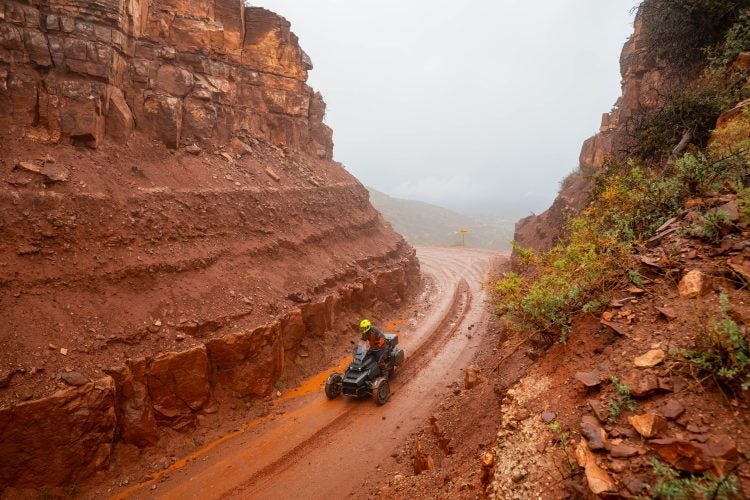
The Canyon handled the slop nicely, and I think that with even more time aboard the trike, it would have been a lot more fun as I learned the limits of its handling.
In other words: This machine does exactly what Can-Am says. It opens adventure travel on unpaved roads to just about anyone. It does not allow much in the way of hoonery. Buy a motorcycle if you want that.
To me, the greatest display of the Canyon’s capabilities was a ride around a slippery mountainside clay road during a rainstorm. This section would have been challenging for many experienced motorcyclists; noobs would have had no chance. But we just plugged away and got around it with relative ease on the Can-Ams. I will say it was slightly unnerving, trusting unfamiliar three-wheeled handling dynamics, which were quite apparently being kept on-track by a busy traction control system, but it worked.
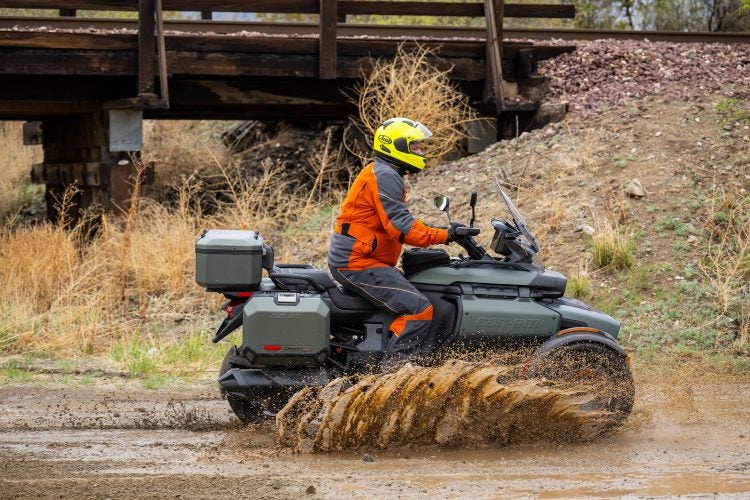
No worries about riding through slick mud on this stable platform.
So who’s it for?
First off, you’ve got to have money to afford the Canyon. The base model is priced at $25,299 in the US; the XT is $29,799 and the Redrock is $32,299 (Canadian pricing is $30,999, $36,999 and $40,499 respectively). This is before you start accessorizing or paying taxes and other fees.
But for those who’ve got the dough: I think, as Can-Am says, the Canyon does a good job of making the world more accessible, whether that’s on unpaved roads or beat-up pavement. For older riders, or perhaps those with a disability, the Canyon might not take you down the tight trails, but it will expand your horizons nevertheless.
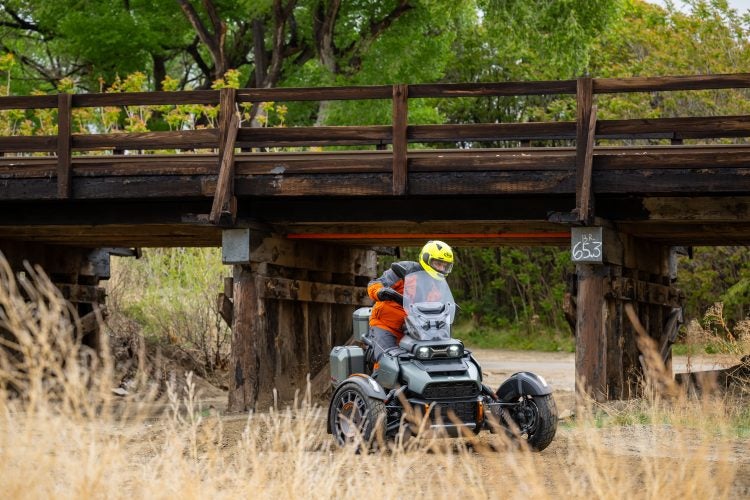
I tried to leave a big spray of roost here, but the electronics said no. Tinkering with the TC settings (you can even make a custom mode on the Redrock model) might have let me hoon around quite a bit more.
It also allows a rider to carry a lot of luggage without too much concern for the weight. This fact, combined with the ease of riding, makes me think these will become quite popular machines for exploring the north. Just think: There’s no real romance in sliding around Labrador or Alaska or the Yukon Territory on a long, straight mucky road; you aren’t corner-carving on those highways. A machine like the Canyon will not only let inexperienced or disabled riders travel to such destinations in safety, it might also work well for riders who need to bring a lot of equipment—a CPAP machine or whatever. Or what if you want to bring a pillion rider, but you want to keep things as safe as possible? There are more people in these situations than you might realize.
For me, I am not going to sell my motorcycle collection and buy a Canyon, but I am looking forward to the next time I get a chance to ride one. With the ability to haul a lot of gas, camping equipment and fishing gear, I might have found a fun machine for a freelance trout-chasing trip to the Canadian north…
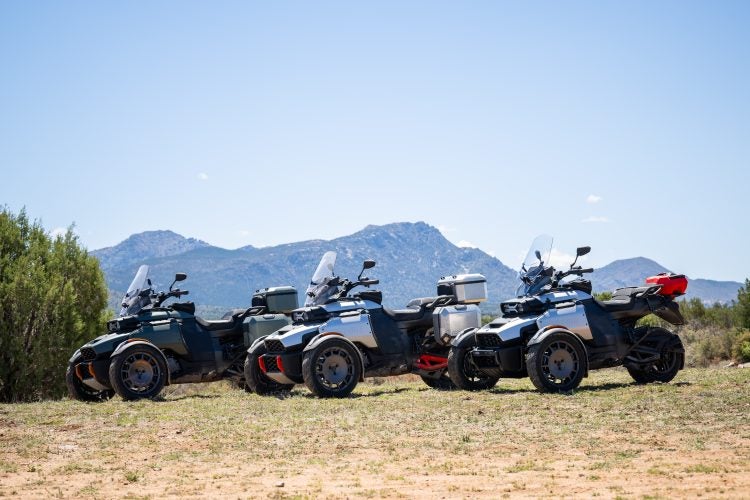
The base model in foreground, with accessory gas jug; the XT behind it, and the Redrock in back.
See Can-Am’s Canyon lineup at BRP’s website here.
Photos: Align Media