

New York is a complicated and weird state. It’s basically comprised of the most populous city in the US attached as an appendage to a massive rural area that mixes Appalachian mountains, Great Lakes and St. Lawrence coastlines and New England farmland. Most tourists go to New York to see Manhattan and the rest of the Big Apple, but if you’re on a motorcycle, it’s well worth visiting the rural parts instead—and the town of Ogdensburg is a good place to start.
A time machine town
Europeans settled the area around Ogdensburg about 275 years ago, but it didn’t really become much of a town until after the War of 1812. Even now, in the 2020s, its population is only around 10,000 even though it is the only American port on the St. Lawrence Seaway. When you ride along the town’s edge on Highway 37, up the side of the St. Lawrence River, you don’t see a horizon filled with skyscrapers; you see low, modest buildings in a town where the pace of life is not that terribly changed from what it was 20, 30, 40 years ago.

Ogdensburg in winter. It’s a town of small buildings, a lot like most of America was 50 years ago. Photo: SEALANDSKY Photo/Shutterstock.com
If you get off the highway and roll through the streets that lead down to the river, you’ll see scenery that should be familiar, if you’ve seen Norman Rockwell paintings or other art from the age of the post-World War II American empire. These sidewalks are quiet on a Sunday afternoon, with large hardwoods shading front lawns. Not every neighborhood is nice and the town is far from rich, but it’s the kind of town where home ownership is still in reach of many locals.

The Frederic Remington Art Museum is housed in this 215-year-old house in Ogdensburg. The building itself is a piece of art. Photo: Zac Kurylyk
Still, there really isn’t much to see in the town itself except for the Frederic Remington Art Museum. Although Remington was one of the best-known painters of the American West in the late 1800s and early 1900s, he was actually from the state of New York. The sprawling mansion that houses the museum was actually the residence of Remington’s wife after he died in 1909, and has served as the museum housing his works for about 100 years.
The museum is fascinating for several reasons. First, it has an amazing collection of Remington’s original sculptures and paintings. Many of these artworks are practically the living definition of Americana, having served to illustrate tales of the West for the past 100+ years. Wandering the halls, you’ll see the original canvases that defined the public’s perception of the frontier, many of them painted from Remington’s memory of his own time there.
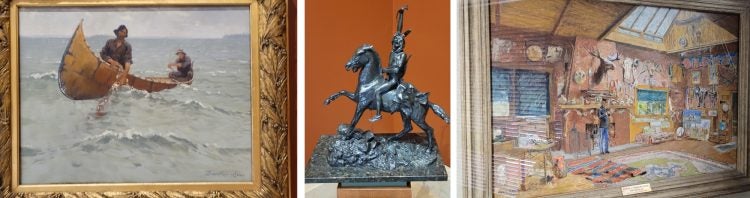
The galleries of the museum are filled with paintings and sculptures from Remington’s life at home in New York, and on the plains of the West. Photo: Zac Kurylyk
That’s the second thing that’s so fascinating about the museum—it is not just a display of art, but also a look into how the myth of the Wild West was created, a myth that shaped the American mindset until, arguably, 2004. That year, HBO’s Deadwood struck the killing blow to the romance of the cowboy. Wandering around the museum, it’s easy to see how generations of not just Americans but also Europeans were entranced by the frontier, and it gives you some insight into how that happened.
Leaving town
But you didn’t ride to Ogdensburg just to wander around a museum and see some boomer-era housing, did you? Leaving town and heading in a general easterly direction, you’ll find more small towns built along more-or-less the same lines; eventually, farmland takes over.
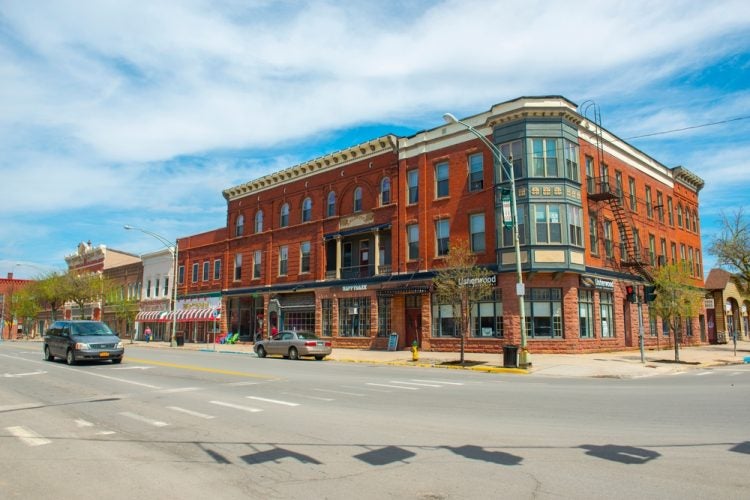
Potsdam, New York. Like the other towns in this area, a lot of buildings look a bit run-down, but still show the glory years when money ran more freely. Photo: Wangkun Jia/Shutterstock.com
Even here, you get a glimpse into America’s past. For the most part, these are small farms, many of them owned by the Amish. Their pattern of self-sufficiency is how much of the country lived up until World War II and the changes that came afterwards due to electricity and internal combustion engines.

An Amish farm in upstate New York. Many of the older family-owned dairy farms in this area have shut down, leaving the population economically depressed. But Amish have come in, bought up the land, and started their own communities. Photo: Doug Lambert/Shutterstock.com
The pavement here isn’t super-twisty; these meandering two-lane farm roads have just enough bends to keep you from getting terribly bored. But when you get out of the fields and head into the hills, then the mountains, as the roads go easterly, there are more and more curves to keep you entertained. By the time you’re in the Adirondacks to the direct east, or the Catskills to the southeast, you’re into some of the best roads on this side of the US.
I haven’t been through here often enough to recommend a specific route as being The Best There Is, but I do know that Ed Conde, the mastermind behind the New England Riders online moto-forum, says New York has the best riding in the Northeast, and I believe him. You can check their B.O.N.E. list for that group’s recommendations for top roads in the area. You might have to dig deeper if you want suggestions for gravel roads or trails.

The self-sufficiency of the Amish shows how most of this area lived up until World War II. Phtoto: Karen Gazzard/Shutterstock.com
All I will say is that I’ve been through this area in late fall, early spring and mid-summer, and the temperature was unpleasantly cold when I rode through early and late, and unpleasantly hot in July. I’d suggest traveling through here in September or maybe mid-May, before the Memorial Day crowds clog up the roads. I had to make some, uh, daring passes to get past traffic when I rode around Lake Placid in July.

A rider scoots through the Catskills. The further east you go, the better the roads get. Photo: James Parascandola/Shutterstock.com
But it’s well worth visiting New York’s upstate farmland and its rural mountain wildernesses no matter what part of riding season you’re in, because this, too, has that same old-Americana feel as the town of Ogdensburg. These hills were the sets for famous books that defined the American frontier even before the Wild West was explored, books from authors like James Fenimore Cooper. Get off your bike, go for a hike in the Adirondacks or the Catskills, or explore Fort Ticonderoga if you get that far to the east. The past is right there, on display.
Getting here
Any time I’ve been to upstate New York, I’ve crossed the St. Lawrence from Ontario over the Seaway Skyway Bridge in Ogdensburg, a suspension bridge with steel grating deck. This is a bit unpleasant when the wind is blowing and the temperature is around the freezing mark.

The Seaway Skyway bridge from Ontario to upstate New York can be unnerving if the weather is rotten. Photo: JohnInNorthYork/Shutterstock.com
But there are major highways from the south, east and even the north (from the Canadian province of Quebec). However you get here, don’t stay on the main drags for long. The back roads in this area are what you want to see, especially the ones that lead through designated and protected wilderness areas. Have fun!