
Some motorcycles become cult bikes because they were good at what they were supposed to do right out of the box. Others become cult bikes because they are easy to modify into improved versions of the factory bike, or something else altogether. And although they’re becoming more rare these days, I think the classic Yamaha XS650 series might be the best example of a bike that felt like it was built to be tinkered with.
XS Origins
The Honda CB750 gets lots of love for revolutionizing the Japanese motorcycle industry, and the rest of the world’s moto industry with it, in the years following its 1969 debut. No doubt the original four-cylinder Honda was a game-changer, but I believe the Yamaha XS1, which hit the market only a few months later, was also a very important player in that era.
Consider the facts. While the CB had lots of power, disc brakes and an exciting new engine, the XS1 was introduced with more familiar components. Drum brakes front and rear, a parallel twin engine with 360-degree crank and a look that screamed “Brit bike.”
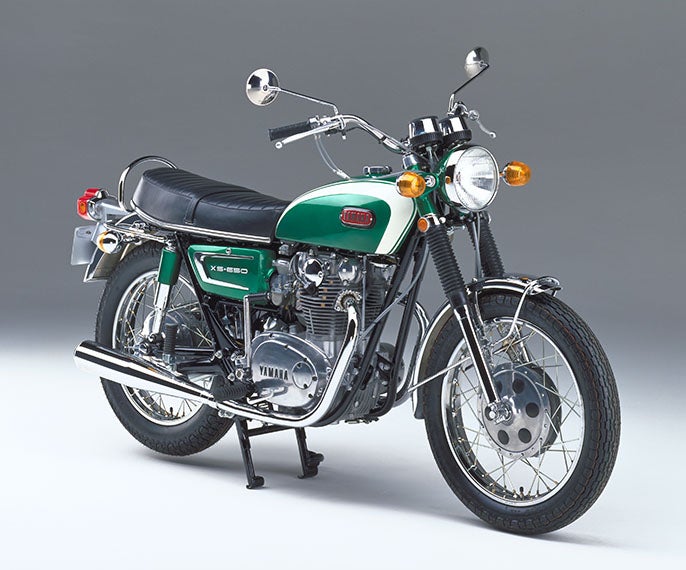
The original XS1 was Yamaha’s first four-stroke motorcycle. The technology was refined from an earlier German design. Photo: Yamaha
The XS’s air-cooled 653cc powerplant was the first four-stroke engine from Yamaha, which might have caused some buyers to beware, given the teething problems that many OEMs face on early-production machines. But there were no real problems with the XS because it was proven technology at launch; it was actually based on a 500cc parallel twin from German manufacturer Hosk, dating back to the mid-’50s. Hosk designed a big-bore version of that engine, then Showa bought Hosk, then Yamaha bought Showa, and by the late ’60s they had refined the design into an engine that looked like a classic British twin-cylinder, but with a SOHC top end instead of fussy pushrods.
The machine was an instant hit with riders, quickly evolving into the XS2 and then the XS650. Unlike the SOHC CB750, which went out of production in 1978, the XS’s production ran until at least 1984, depending what market you were in. There was a standard model that looked a lot like a Bonneville, with a straight seat and general Brit bike vibes. In later years, Yamaha tied itself to the custom/cruiser scene with a Special and Heritage Special version of the XS, with a low-rider stepped seat, lots of chrome and buckhorn handlebars. I owned one of these for a while, and it was a good, beginner-friendly machine.
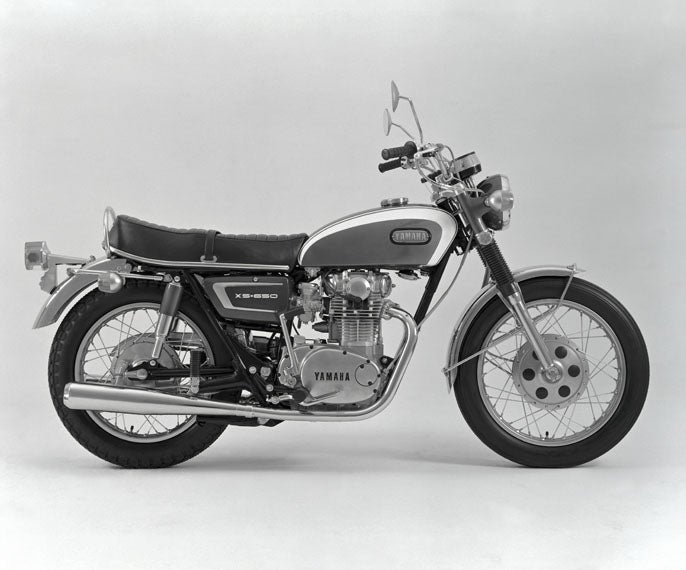
Drum brakes were standard on the first-gen XS, updated to a disc setup in front in later years. Every XS I have seen still had a rear drum brake for the full production run, Photo: Yamaha
That long production run and high customer demand in Europe, North America and Australia meant Yamaha made a lot of these bikes. Most estimates run around 300,000 machines in total. And while there were a few updates over the years, even after the XS2 became the XS650, the formula was the same basic design, and many of the updated parts on later models (disc brakes, electronic ignition) could be fitted to older machines. None of the updates changed the fact that this was a low-performance machine (50ish horsepower, and about 430 pounds wet), but better brakes and a more reliable ignition were still welcomed by most practical riders.
What made the XS great?
If you wanted a full-sized, uncomplicated, affordable motorcycle that looked right and felt right, the XS was a great choice. Not everyone wanted to chase four-cylinder performance, and if you didn’t need a 750 or 900, the XS was there at a lower price, excellent reliability and lighter weight than even middleweight fours like the CB550.
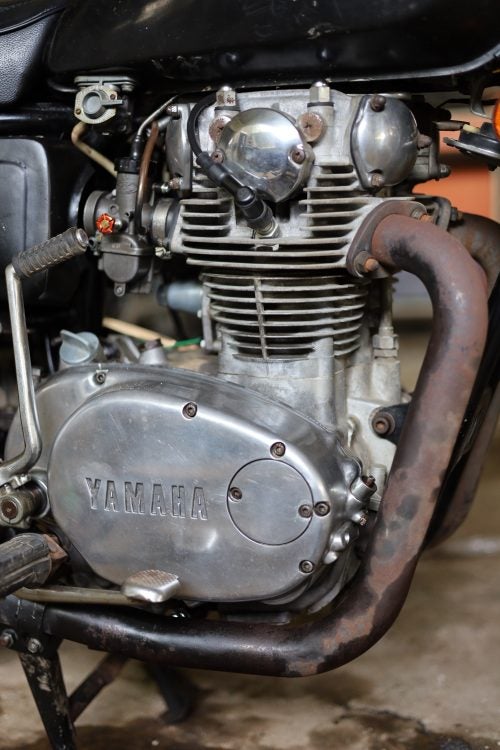
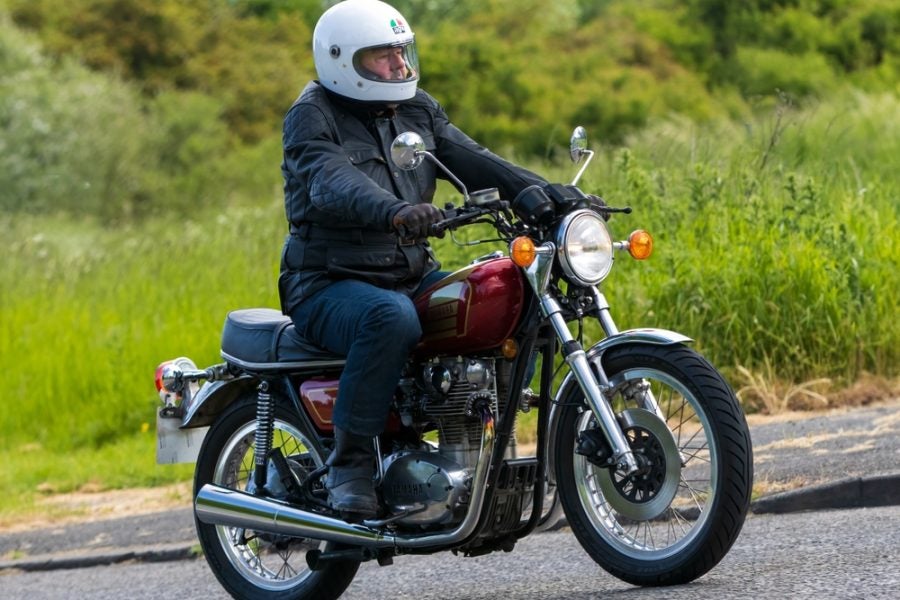
One of the easiest engines to maintain that Japan ever made, in my opinion. I owned one, and found it easy for even a new rider to tinker with. Also, note the crusty condition. The last XS650s were made 40 years ago, so this is the norm for most private-sale machines. Photo: Uud N. Hudana/Shutterstock.com
And it was easy to work on and modify. After only a couple of years on the US market, tuner Shell Thuett had Kenny Roberts winning AMA dirt track races with an XS-powered flat tracker. In the following years, plenty more were turned into flat trackers, then street trackers, cafe racers, choppers, brats, and whatever else you could imagine.
To this day, the XS650 has some of the best aftermarket parts support of any vintage Japanese motorcycle, with Mike’s XS providing any kind of useful part imaginable. You can get the basic stuff needed to keep your bike going in mostly-stock form, or you can go for a big-bore kit, upgraded ignition and lots of other fun stuff. Other places will sell you an ignition, cam and crankshaft rephased to 277 degrees, to theoretically smooth out engine vibration as well as change the bike’s power delivery.
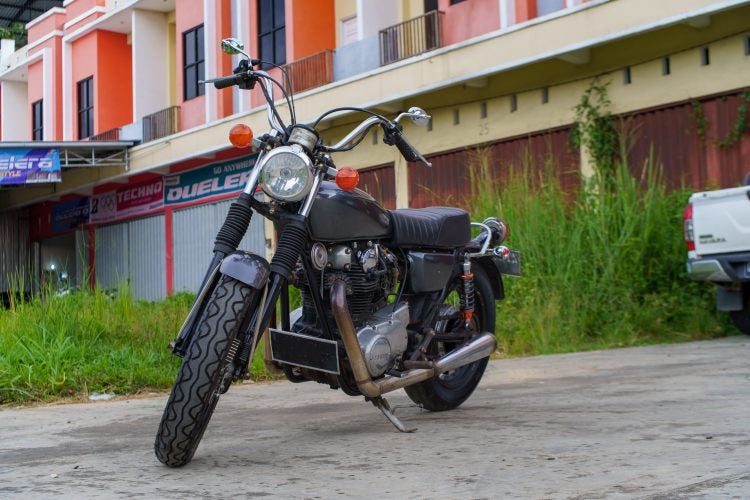
Check out that oil cooler! This Indonesian-owned machine has some basic modifications that should improve performance without trying to transform the look. Photo: Ahmad Sibawaihi7/Shutterstock.com
This means customization of these machines ranges from mild to wild, and they may be the most hacked-up Japanese motorcycle ever made, even more-so than the CB series. I think Yamaha’s SR400/SR500 series would probably be the closest competition, due to its even longer production run, but I don’t think anything else comes close.
Buying an XS650
A good-condition XS650 in good running order, with minimal modification, is hard to find, but a slightly crusty example is not terribly difficult to pin down. This 1975 model, for sale in Maryland for $2,500, is more-or-less what you can find without looking too hard, and that price is probably in the ballpark of what most sellers expect for a bike like this (this doesn’t mean they’re guaranteed to get it).
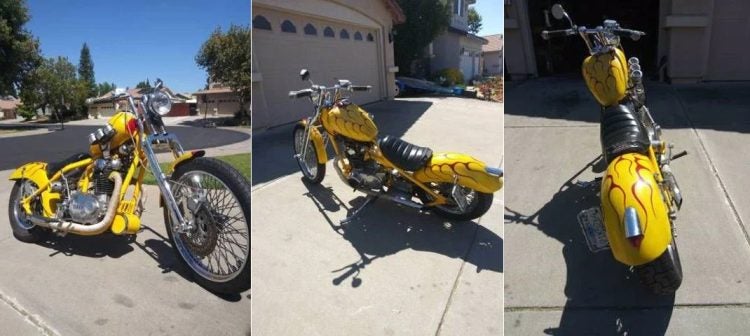
A 1974 machine for sale in Michigan shows one route that a lot of custom builders took; the XS was easy to chop. Photo: Classic Car Deals
Heading over to Autotrader, you can see this 1974 model pictured above for sale at a classic motorcycle dealership in Michigan. Asking price: A cool $7,495. Is a vintage chopper worth that money? YMMV…
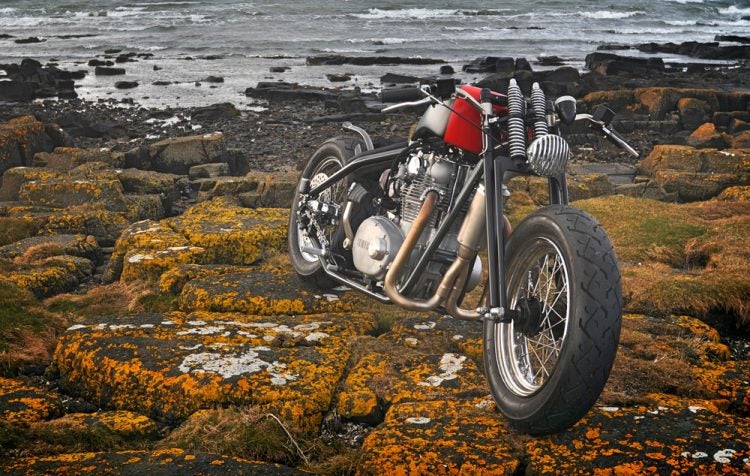
Another modified XS, this one not for sale as far as we know. Beauty is in the eye of the beholder, right? Photo: Alpix 1/Shutterstock.com
In the US, flat-tracker style builds have long been popular, with Omar’s a go-to source for many builders wanting fiberglass bodywork. Seen an example below.
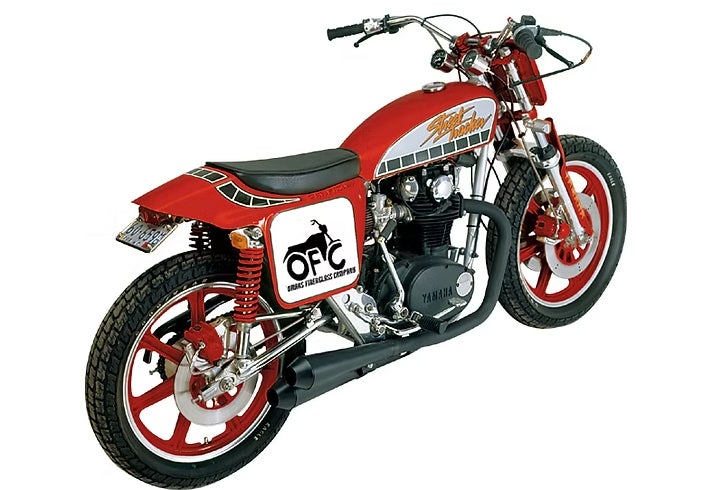
The XS is a popular base for tracker-style customs. Photo: Omar’s
I have also seen some XT-looking dual sports made of the XS650, and thanks to the power pulses delivered by that twin-cylinder’s firing order (basically, it runs like a single cylinder with two pistons), they hook up well in the dirt. It is certainly a good base for a scrambler build—see here for a whole host of examples.
Whatever your taste, there is at least one advantage to buying a customized XS—it will generally be in better cosmetic condition than a stocker, and often will have the ignition and maybe other components upgraded. If done correctly, these mods will save you work and expense down the road. Again, YMMV…