

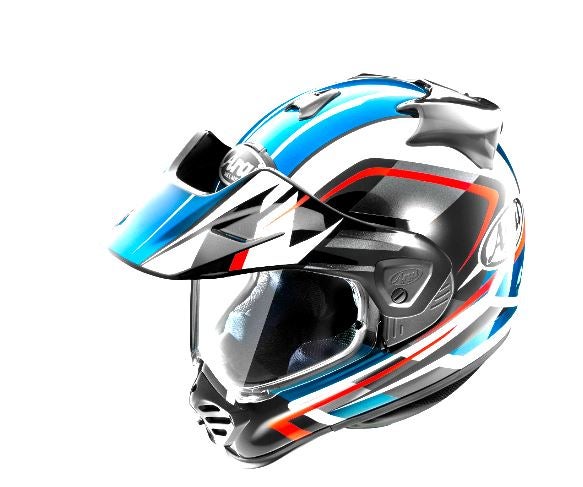
It has been several years since Arai last updated its “XD” series adventure motorcycle helmet. The XD helmets have a very loyal following, but as time marched on, competitors caught up, and some riders say they surpassed Aria’s XD adventure offering. It was time for Arai to update its lid to bring it in line with its competitor’s newer and sometimes substantially lower-priced helmets. With the release of the XD5, Arai has tried to up its adventure helmet’s game with several new features based on its time-tested adventure series helmets.
Arai’s helmet protection philosophy is based upon the theory of “glancing off.” What they mean by that is that their helmets have a rounder, smoother shape that allows the helmet to “glance off” the surface it comes into contact with, reducing the energy transmitted to the rider’s head. As a result, they forego other protection schemes that some helmet manufacturers have adopted, including “sliding” inner liners (such as MIPS), mini shock absorbers in the helmet’s liner, and “smart” helmets that can call for help. Whether all or any of these “new” technologies substantially increase safety is a subject of hot debate.
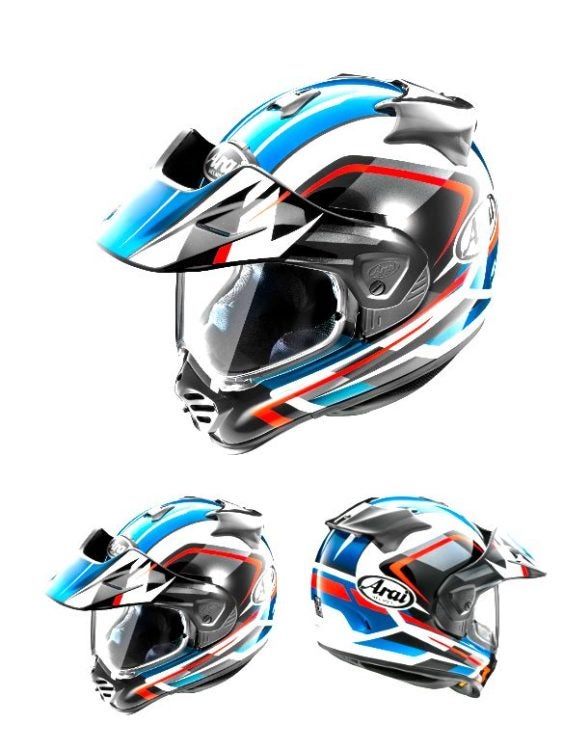
This is the helmet Arai sent in Discovery Blue. The fit and finish is excellent. Photo: Arai
So, let’s examine Arai’s XD5 and discover what’s new, different, and unchanged.
Revisions
Arai has made several changes to the XD, some of which I really like and others not so much. We’ll get into the “yays” and “nays” shortly, but for now, here’s a list of XD5 changes:
- There are now four different shell sizes depending on the size of the helmet chosen. The shell is an all-new design and uses PB CLC construction (peripheral belted complex laminate construction). The XD5 is wider side to side and shorter front to back than the XD4 it replaces and is designed for the common North American intermediate oval head shape.
- The face shield can now be removed without the use of any tools or a coin. To remove the face shield, you push a lever and pop off the side plate. It’s a similar process to re-insert the visor.
- The helmet peak has also been extensively redesigned to make it smaller front to back, reduce buffeting, and allow air to flow more smoothly. It is still removable with the use of a screwdriver or coin.
- The chin intake vent has been redesigned and is twice as large as the previous version. It can also now be set to be partially open, versus the XD4’s all-open or completely shut. You can also adjust the direction of the airflow into the helmet with a shutter on the inside of the helmet. The new chin vent cover is also removable, so the internal and external vent areas can be washed, which is very nice if you often ride in dusty conditions.
- Arai has redesigned the XD5’s face shield. It has a single detent position that keeps it open halfway at speed. At lower speeds, you can adjust the visor position and have it stay in place. However, with the redesign, the visor’s smooth surface has disappeared. It has been changed and now has a “stepped” area around the face shield’s perimeter. It can cause some distortion; more on that later. The eyebrow vents have also been removed.
- A new rear spoiler is supposed to reduce turbulence around the helmet and provide a better exhaust.
- Interior components like cheek pads, helmet liner, and neck roll are readily removable and washable.
- Larger speaker pockets accommodate larger and thicker speakers without removing the helmet cheek pad covers. There is now a dedicated area for them, and they allow the speakers to be placed more comfortably further away from your ears.
- The new XD5 design offers more internal headroom. This allows air to flow better inside the helmet. In addition, the inner liner can now be adjusted for a more personalized fit. Cheek pads can also be slimmed down by up to 5mm by removing the pre-scored cheek pad material.
- There are now 3 intake vents: one at the chin, one under the Arai logo, and one at the crown of the helmet. All but the vent under the Arai logo can be set to full, partially open, and closed. The vent under the logo is either open or closed.
- Four exhaust vents help keep the air cooler and moving. The rear exhaust ports have a new single spoiler replacing the two small separate switches and covers. Now, a single slide switch allows for open, partially open, and closed settings.
- The XD5’s standard face shield is now Pinlock ready. Arai provides one in the box with the XD5. Previously, if you wanted either one, it was at an additional cost.
- Larger speaker pockets accommodate larger and thicker speakers. There is now a dedicated area for them.
- Aria’s Hyper-Ridge has been revised to provide a flatter surface for easier mounting of communication devices.
- A new pocket has been incorporated into the neck roll for easier routing of communication device wiring.
Size and fit
Perhaps the most important factor in determining whether a particular helmet brand is for you is how it fits your head. A snug, comfortable fit is the key to ensuring there’s a lid on your head when you ride. If it isn’t comfortable, you won’t be wearing it. So make sure that the helmet fits your head with a snug, comfortable fit. In my case, the XD5 does both. It’s comfortable and snug.
The TLDNR: I’ve owned Arai’s XD3 and XD4 helmets in the past. But overall, the DOT and Snell 2020-approved XD5 is much more comfortable than its predecessors. However, there’s one exception. With its shorter front-to-back measurement, the helmet’s breath deflector is very close to my face. Sometimes, it would touch the bridge of my nose. As a result, I removed it, and the issue has been solved. Just be aware that the shorter front-to-back measurement will bring the helmet’s chin guard, and breath guard closer to your face.
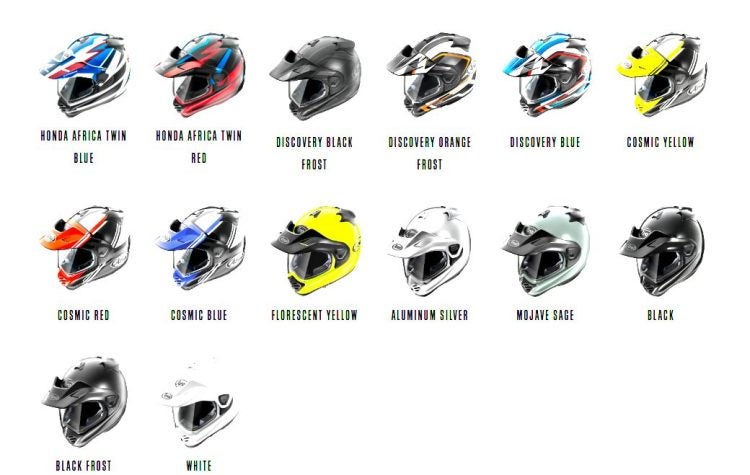
Arai’s XD5 comes in many different colorways with solids being the least expensive. Photo: Arai
Aero qualities
The XD5’s shape change has also affected its aero qualities. While Arai has shortened the helmet front to back, it has also made it wider from side to side. Arai says the change was made to make the helmet easier to put on and take off. However, I didn’t feel much difference.
Unfortunately, the changes in helmet shell shape have resulted in more wind pressure on the helmet’s front and some additional turbulence, making my head move more from side to side. It’s not terrible by any means, but realistically, I found the XD4 to be more stable at speed than the XD5.
That said, the peak now is much smaller and sits higher than before. It has a much larger gap between the helmet’s surface and the back side of the visor. The redesigned peak also seems less prone to catching air during head checks to the sides and rear. So, from my perspective, the redesigned peak is a good improvement, while the new, more rounded, and larger helmet shape is less so due to the increased turbulence.
While the XD5’s new single rear spoiler is supposed to reduce turbulence, I didn’t find much difference with it compared to the other XDs. But its new single lever makes opening and closing the vent faster and easier. You don’t have to check two separate levers at the back of the helmet as in previous generations. You just check the large switch’s position for open, intermediate open, and closed settings with a glance.
While the XD5’s shell dimensions have changed, its weight is pretty consistent. The new XD5, in size medium, weighed 3 pounds 15 ounces, while the XD4 weighed 4 pounds. As you might expect, larger shells will weigh more since more material will be necessary.
Face Shield
The XD5’s face shield and its retention system have been revised. The changes bring some good and some not-so-good attributes. The best thing about the new shield is that it can be removed without using a tool (or coin). To remove the shield, you raise it to the full-up position and push a lever at the base of the visor and side plate. This allows the side plate to pop off, giving you direct access to the face shield. Reinstallation is basically the same, except in reverse.
Next, with the XD5’s face shield raised to its highest position, it now sits higher and out of your field of vision. With the XD4, the face shield was always at the top of my vision and was somewhat bothersome until I got used to it. With the XD5, this issue has been entirely resolved.
The face shield itself has also been redesigned. The eyebrow vents have been removed and replaced by a front vent placed under the Arai logo. The shield is no longer a smooth, flat piece of acrylic. It now features a “stepped” design that provides a better seal between the helmet and face shield. That’s good news, but on the flip side, when the visor is in its intermediate open position, it does distort your view somewhat.
For those of us who like to ride with goggles, Arai says that most goggles will fit into the helmet with the visor fully raised. My cheap goggles did indeed fit, but if you wear “large” goggles, be aware it might be a tight or even non-fit.
Inside the XD5
Once on, the helmet feels much more “airy.” There is more open interior volume, which makes it feel much less like having your head stuffed inside a mold. It just feels more open and comfortable. Part of the newfound space can be attributable to the much larger and deeper speaker pockets. As a result, your helmet speakers can be placed further from the ear for more comfort. With the XD4, I was consistently unfolding my ears after putting the helmet on. I am currently using the Cardo Packtalk Pro (review coming soon) with their larger 48mm speakers, and I no longer have this problem.
With all of the XD5’s vents open, it did seem that there was better airflow than in the XD4. I wasn’t able to ride in super hot weather to see if they provided more cooling, but it did seem that more air was moving inside the helmet. With the additional airflow inside the helmet and the more open interior space, the XD5 seems to be a bit louder than the XD4, and there’s some tradeoff to be made. More air and space inside the helmet means there’s more opportunity for sound to bounce around the inside of the helmet. However, with the increased sound, I felt that I could hear outside traffic sounds somewhat better than with the XD4. That’s a tradeoff decision that you will have to make.
Pricing
Aria helmets have never been inexpensive, nor have they ever exchanged quality for price. Pricing starts at about $840 for certain solid colors and rises to nearly $980 for helmets in bike-specific colorways. Any way you cut it, Arai helmets are pricey but consistent with “premium” helmet pricing. That said, Arai now offers a few no-additional-cost “upgrades” with each helmet, with each XD5 coming with a Pinlock-ready clear face shield, a Pinlock anti-fog insert, and a dark face shield.
Summary
For me, there are several gains and a few misses when comparing the XD5 to previous generations of the XD series. The XD5 is the most comfortable of them all and also flows more air than previous generations. It’s easier to install and remove the face shield without tools, and the revised peak catches less wind at speed.
Unlike previous generations of XDs, when the face shield is fully raised, it is now out of your field of view, giving you a nice clean sight plane. The new venting system seems to flow more air than previous iterations, and there is now more ability to adjust the airflow inside the helmet. For those of us who ride with helmet communications systems or speakers in our helmets, the larger speaker openings and neck roll wiring space are a welcome addition. The higher sitting face shield also permits easier use of most goggles without having to remove the face shield itself.
On the “miss” side of the new XD5 equation, the new helmet shape seems to generate more turbulence at speed. Its additional airflow lets more outside noise inside. This can be a good or bad thing depending on your desire to hear the outside world while riding. The shortened front-to-back measurement also means the chin guard and breath guard are closer to your face. If you have a good-sized “snozz,” you may want to consider removing the breath guard.
Note: Arai provided the helmet reviewed here free of charge.