
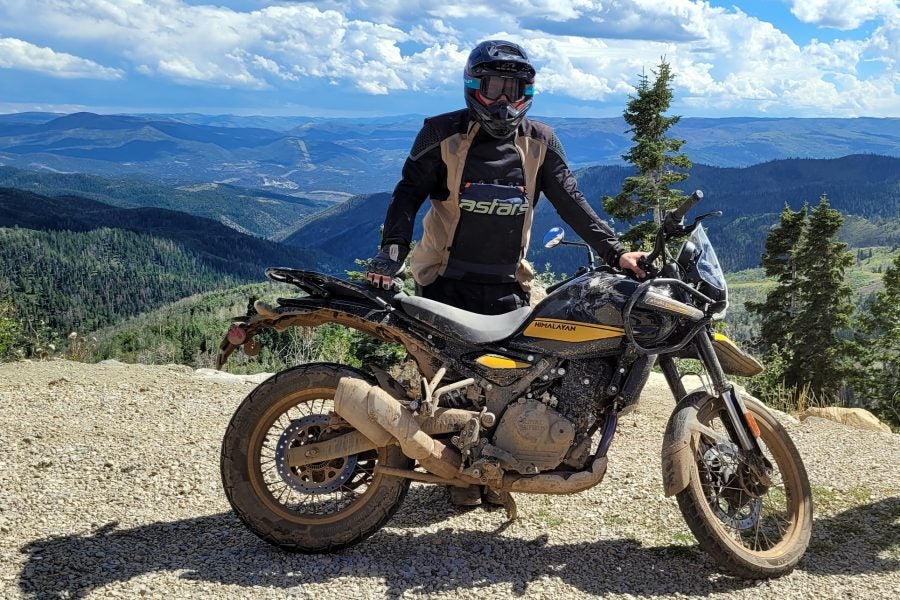
When the original Royal Enfield Himalayan 411 came out, it was a big step in a new direction for the Indian manufacturer—but there was a lot of room for improvement. To their credit, Royal Enfield did incorporate some mid-production updates to the design, but there was only so much they could do with that first-generation platform. So, in 2023, after months of spy shots, we saw an all-new Himalayan 450. This week, I finally got to ride the new bike at its Utah launch.
If you’ve been following this bike with interest, you probably know all the vital tech details, and you can skip forward to the riding review. Otherwise, the important info is listed directly below.
The tech stuff
When Royal Enfield says “All-new,” they really mean it. The engine, frame, suspension—all these systems were designed from the ground up for this bike, although they were obviously built with lessons learned from the old machines.
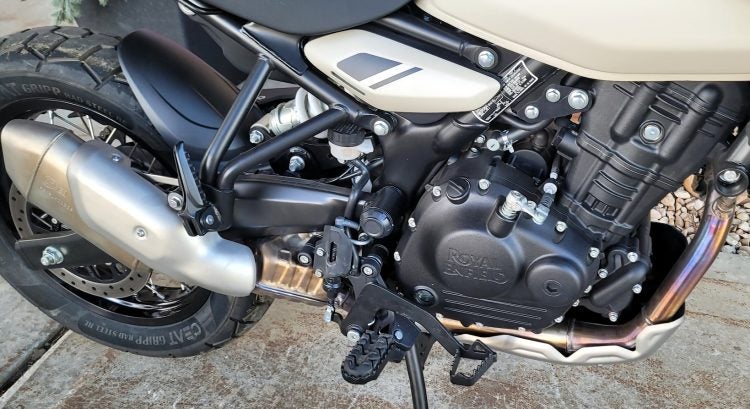
This new engine is going to be a foundation for the Royal Enfield lineup going forward; it’s already been repackaged into the Guerrilla, and we can surely expect other machines to come. Photo: Zac Kurylyk
The heart of the Himalayan 450 is the new Sherpa engine. It’s a liquid-cooled single with 11.5:1 compression ratio, and the rise to 452cc capacity gives it just under 40 horsepower at the crank, and just under 30 pound-feet of torque—the previous bike made about 25 horsepower and 24 pound-feet of torque. The new 450 comes with a six-speed gearbox, slip/assist clutch and two ride modes: Performance and Eco. The power curve looks similar to the original bike, with 90 percent of the torque available at 3,500 rpm, max torque at 5,500 rpm, but you can wind this engine out to 9,000 rpm, with max horsepower at 8,000 rpm.
The chassis benefits from a relocated airbox; Royal Enfield’s designers tipped the ‘box up under the fuel tank, instead of directly behind the engine. This allows them to adjust the shock linkage orientation so it’s not protruding under the bike, waiting to be damaged. While some users might fear the airbox is now less accessible, it is removable by popping off the seat, then undoing the tank’s rear mount, unclipping the fuel delivery hose, and undoing three screws atop the airbox. Looking at the design, I suspect it’s actually less fidgety than that of some Japanese dual sport bikes.
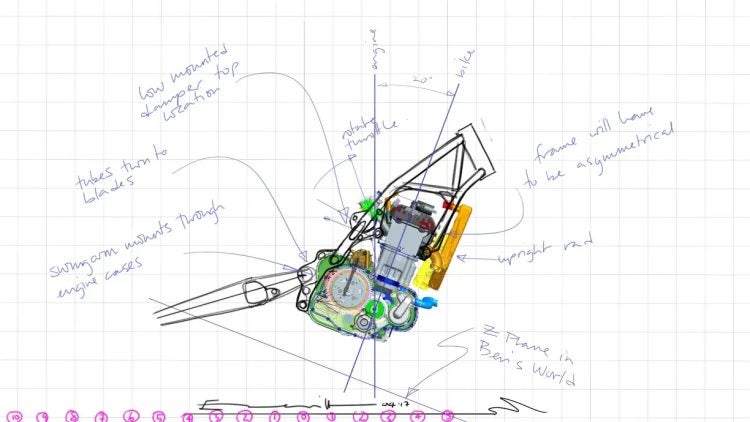
Royal Enfield’s redesigned airbox means it’s a bit more tucked-away, but the engineers reckoned that a good compromise considering the improvements then made possible to the chassis design. Image: Royal Enfield
As for the suspension, it’s Showa-built. The front USD fork is non-adjustable; the rear shock is preload-adjustable, with a spanner that ships in the bike’s toolkit. The front and rear both have 200 mm of travel (about 7.9 inches, an inch more than the previous model had).
The frame itself is steel tube, with the engine serving as a stressed member. The rear sub-frame is a bolt-on affair, with the footpeg hangers welded on the frame.
The brakes are from Brembo’s ByBre subsidiary, with a rear-ABS-off mode, accessible with two quick pushes of a button on the handlebar—very, very slick and easy.
Fuel capacity is 4 gallons, plus a half-gallon for reserve. Fueled-up, the bike weighs 432 pounds at the curb, says Royal Enfield.
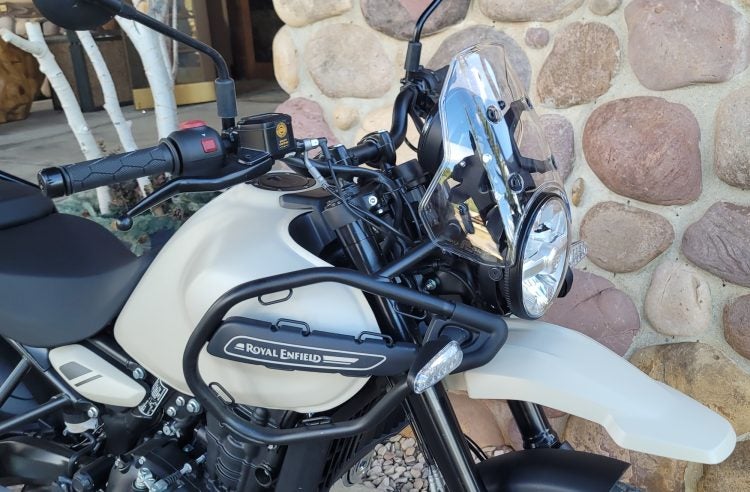
That tank is supposed to be good for better than 250 miles of range. The tank guards protect it nicely in a tipover (believe me, they were well-tested!), and Royal Enfield is working on clever panniers that that bolt right to those bars. The rest of the “Adventure” accessories package will be available in the US this fall, when the main shipment of 450s shows up (not the pre-order models, which will be here a few weeks sooner). Photo: Zac Kurylyk
For the display, Royal Enfield included its Tripper dash as standard. This is a round TFT display (not easy to make, RE’s engineers told us) that displays your speed, RPM and other useful info in an aesthetically pleasing fashion. Pair it with your phone, using the Royal Enfield app, and you can use RE’s Google Maps–derived navigation system as well as control music streaming and your phone’s messaging/call answering. This is a bit of a faff of an arrangement, as due to the limitations of the casting technology used, your phone screen must remain on to use the nav system—meaning that you’re draining the battery faster, unless it’s plugged in. This is due to mobile device limitations, not RE’s design, but you should be aware of it. They do include a USB port on the bike to charge your phone.
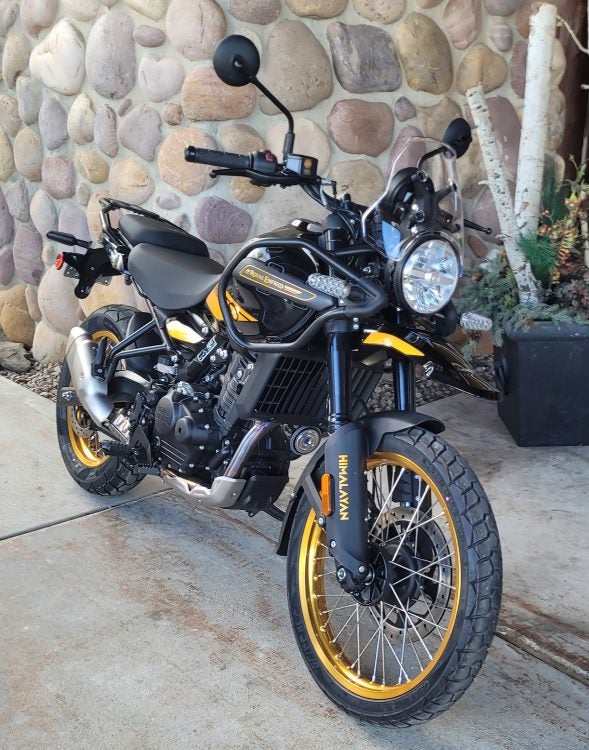
Some of the bikes at the launch came with farkles installed, some didn’t. Mine was stock, but other riders had engine crash bars or rally seat or other parts bolted on. Photo: Zac Kurylyk
The ride
Our ride started with a run up Utah’s Route 40 along the Strawberry Reservoir. At the intro, the designers had emphasized that they’d built highway passing power into the new machine, something that was sadly lacking on the original model. Alas, our group leader didn’t let us run past the tankers along the way to test out the new engine, but it certainly easily held speeds more than 70 mph, and with minimal vibration. Even with the rubber inserts removed from the footpegs (to improve our traction on the pegs off-road), the vibration of the new EFI-equipped, throttle-by-wire, liquid-cooled engine was far less than the rattly air-cooled, carbureted Japanese dual sports of the 1990s and 2000s. The airflow behind the small headlight fairing was fairly clean at highway speeds, too, and the bike felt stable.
And then we split down a canyon road, with a mixture of pavement and dirt. This short section was a quick test of the tires’ and suspension’s true capability on a proper road ride, not a highway run, and all was good, although we were still pretty packed together. From there, after a photo stop, the dirt section of the ride began, and this is where things got interesting.
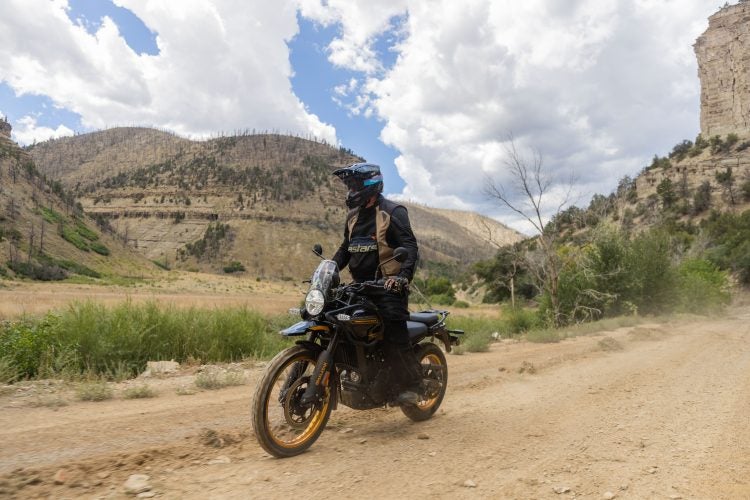
The first Himalayan 450 launch was in the mountains of India. The North American launch event was on the western slope of the Rockies, in Utah; still pretty high-in-the-sky. Photo: Royal Enfield
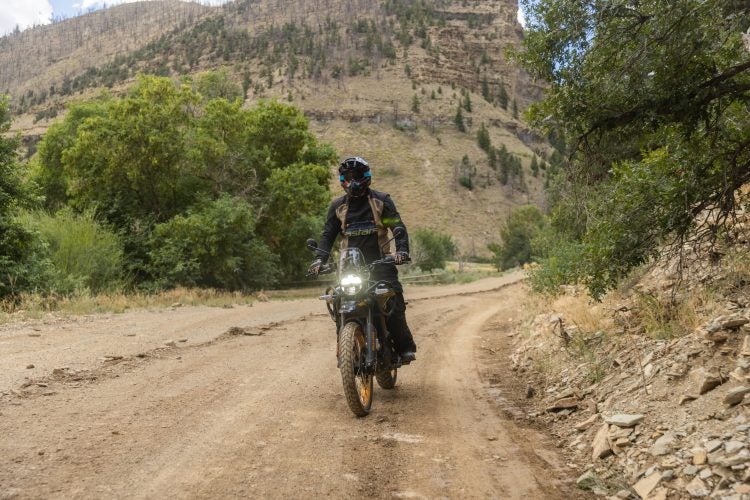
Generally speaking, this bike is pretty good off-road, and considering this is only Royal Enfield’s second adventure bike, I think they deserve a lot of credit here. The suspension worked much better for my hefty 230 pounds than most of the cheap Japanese dual sports I’ve ridden. The rear and front were both planted over almost all terrain as long as I kept a sensible speed—the only spot where I had a problem was a hard-to-see dip in the road that I hit at high speed (as did most everyone else on the launch). I managed to completely bottom out the rear shock, and then had the bike’s rear end spring back up and smack me squarely in the nuts. I thought I was a goner when the front end got squirrely coming out of the dip, but the bike straightened itself out quite smartly and all was well. Speed, as they say, either ends the suspense or solves the problem, and in this case, it solved the problem.
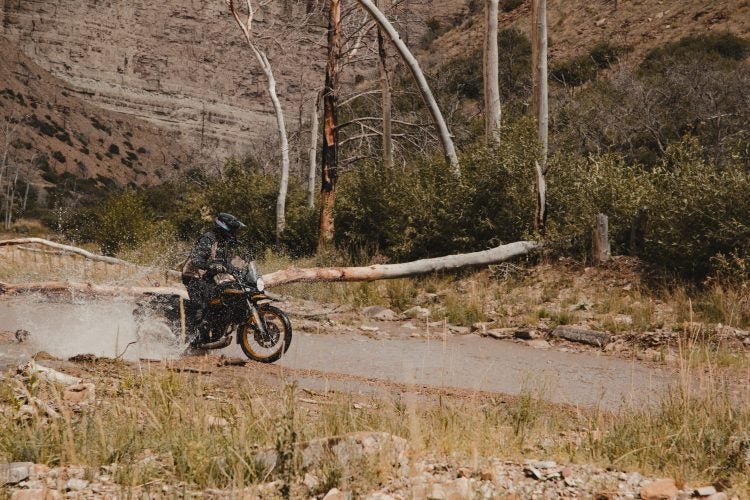
Although the bike’s suspension is basically non-adjustable (rear preload is adjustable, and that’s it), it suited most of us quite nicely at the paces we ran. Photo: Royal Enfield
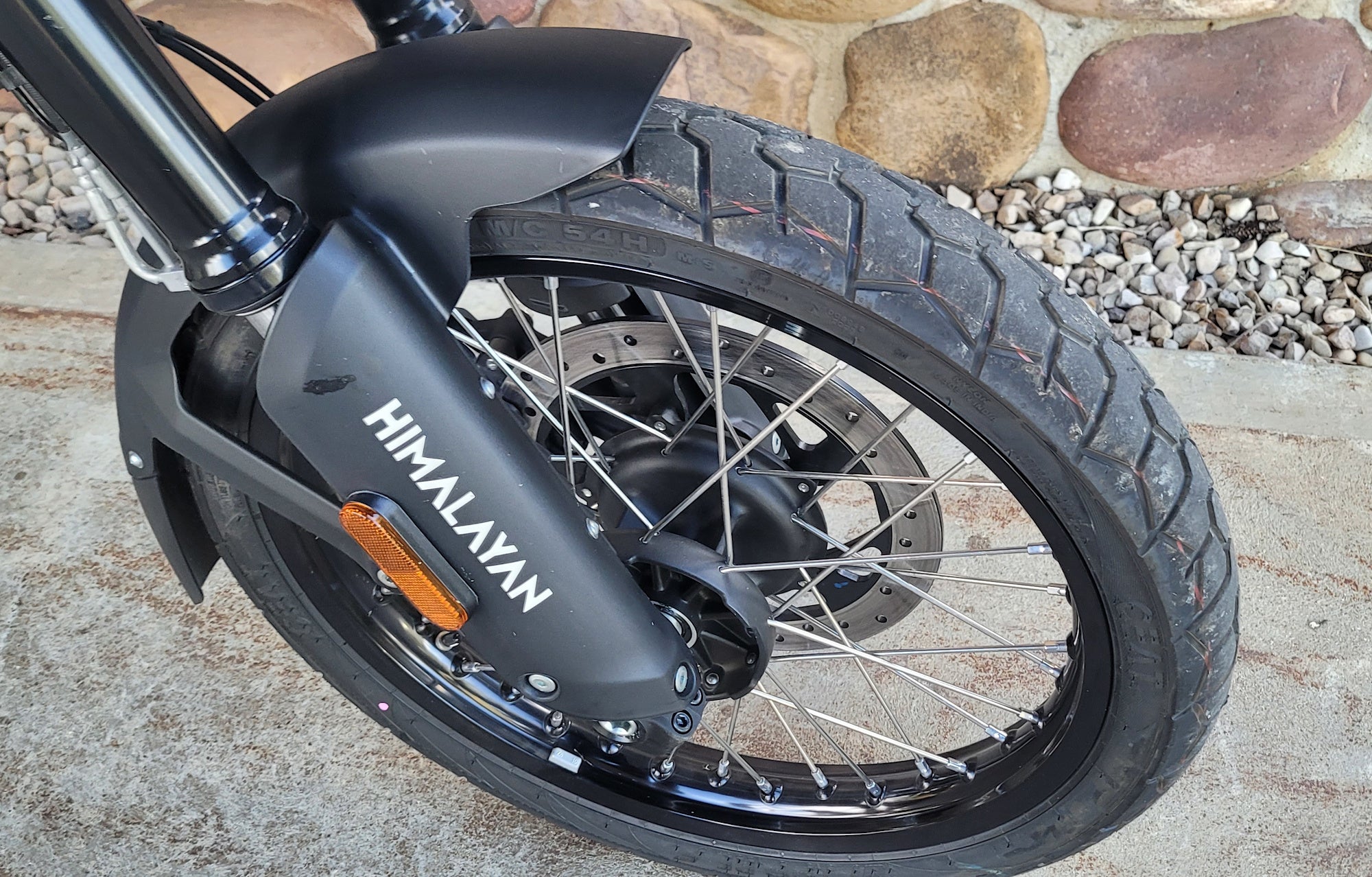
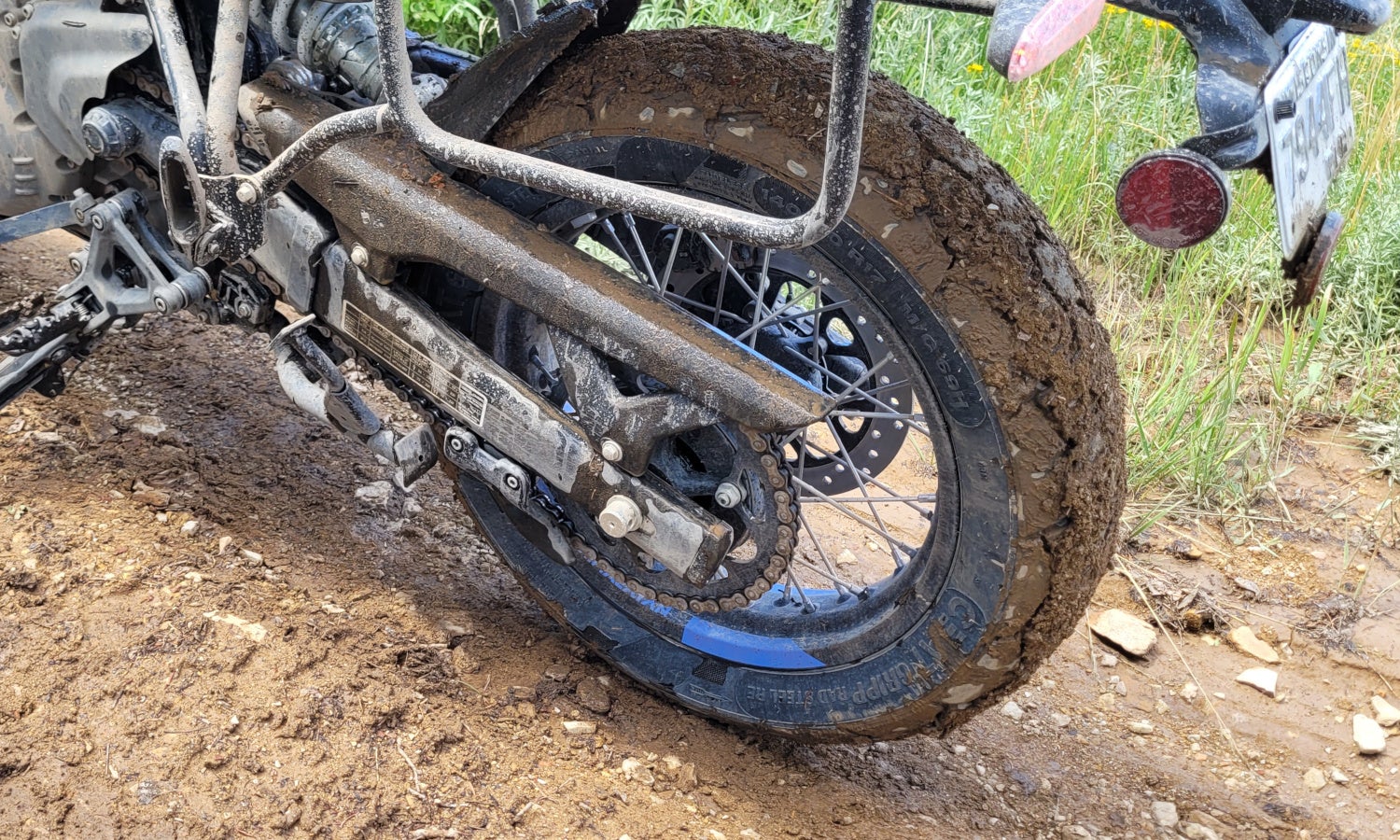
Alas, speed did not solve the problem a few miles later when we hit a longer mud section. While the street-oriented tires did very well in the dry gravel sections, the few mud holes along the open section of the trail showed that the stock rubber (21-17 CEAT tires, with tubes) was not great when the going got slippery. Then, when we got into the woods, with trees preventing the dirt from drying out as well, three of us managed to end up crashing in a bunch on what looked like a straightforward section when the tires’ treads filled with mud.
-
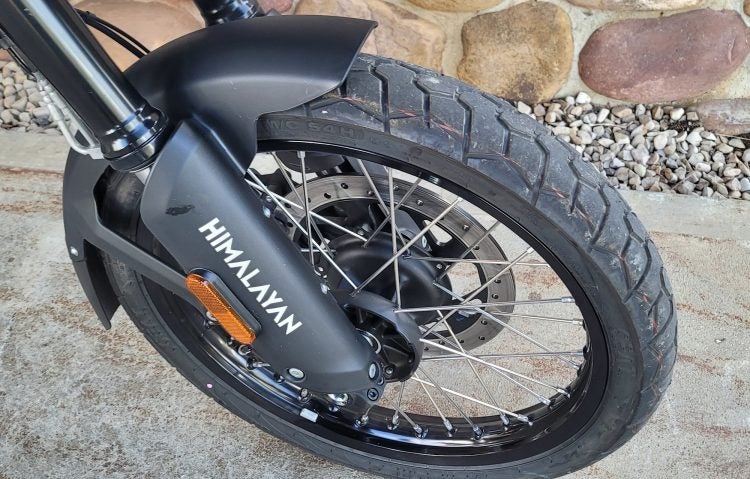
- A tale in three photos. First, these are the Himalayan 450’s stock tires. They have excellent grip on the street and are surprisingly good on dry gravel…
-
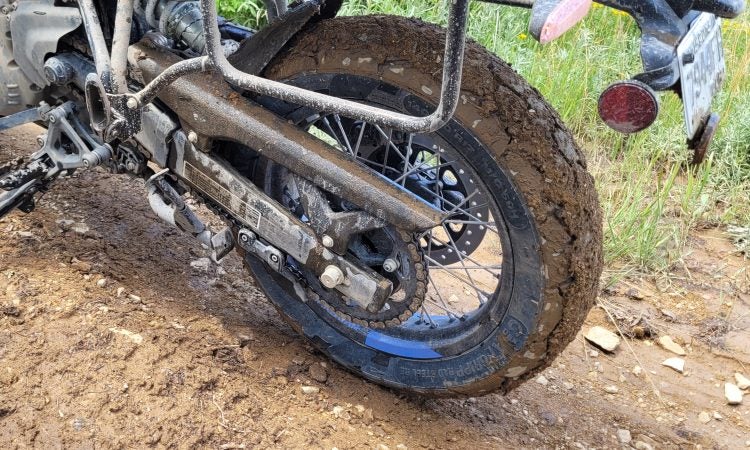
- … but they clog up quickly in the mud, which means…
-
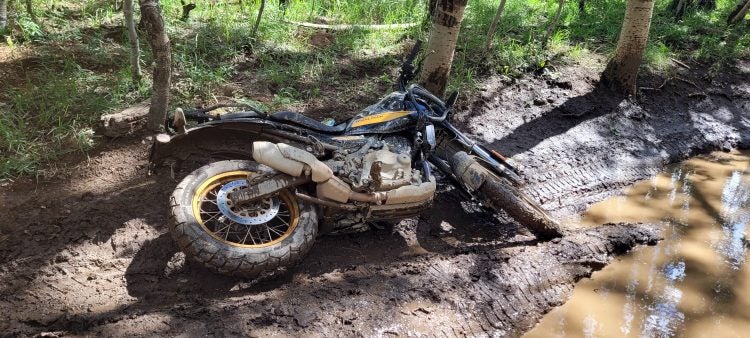
- … that this happened for a bunch of us at the event.
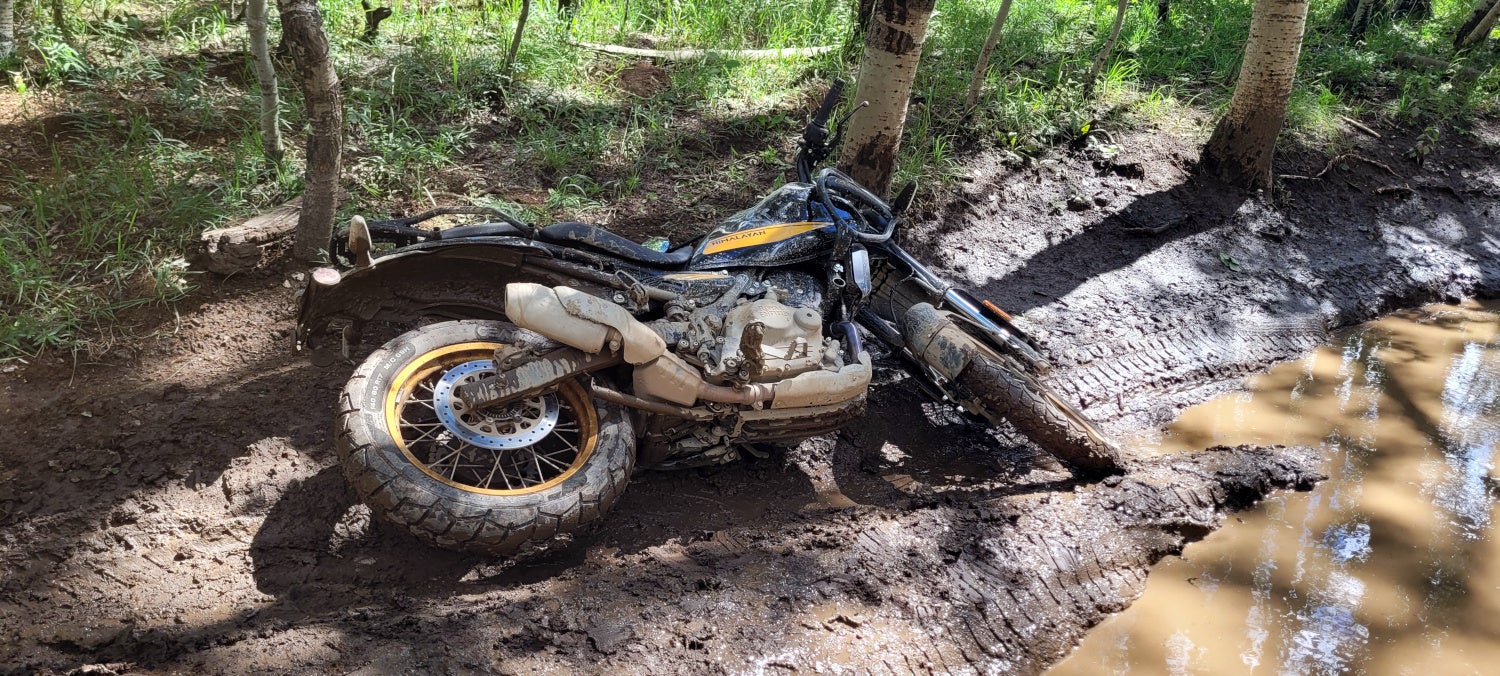
Thankfully, none of us ran over each other, but I banged my ribs up pretty badly and another rider wrenched her knee. But I managed to get back in the saddle and ride to the lunch stop, with two lessons learned: First, beware the slippery terrain. Second, the bike crashes really well.
This is an important point, because it is not true of all adventure bikes; they weigh enough to seriously hurt you, or they have a plasticky design that breaks easily when it hits the ground. Between the crash bars on the bike’s tank and a design that is generally robust, the Himalayan 450 can handle rough misuse, and that’s a very good thing if you buy this machine and want to ride it hard.
Thankfully, the bike handled the tip-overs and other bumps well. I don’t think anyone lost anything beyond a mirror. Photo: Royal Enfield
After lunch, the ride route climbed to a mountaintop route in the area around Strawberry Peak. The terrain was tricky, requiring careful steering around lots of ruts and washouts, but the bike handled it quite well. Only the slimy parts were really tricky, because the tires’ treads would clog up, and there were more tip-overs and mud puddle baths to come. But aside from that, I found the Himalayan was far more competent than I would have expected—I was glad to see the designers hadn’t BS’d us during the pre-ride presentation.
During that meeting, we’d got the usual “We tested and thought carefully about every system on this bike” spiel. The same old thing you always hear at a press launch. But after riding the bike for the afternoon, yes, there were some little things that could have perhaps been improved, mostly due to riders’ fitting the bike, but overall, this feels like a machine that was developed from a lot of hard work at getting it right. It is easy to live with.
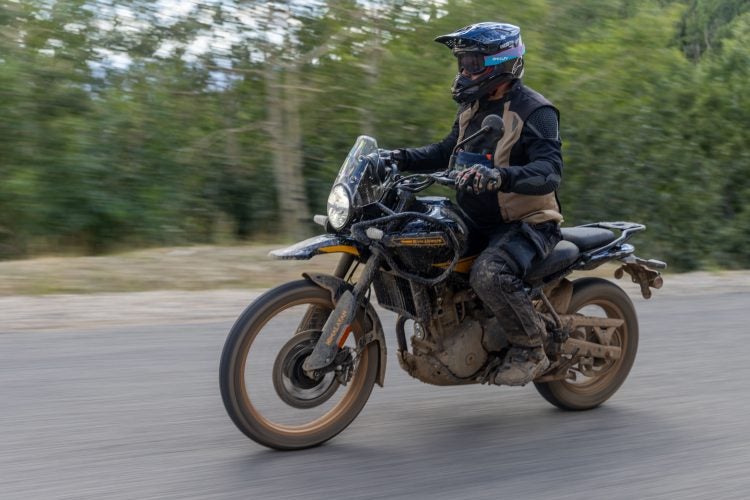
Is it a dual sport? A scrambler? An adventure bike? Whatever label you want to stick on it, it works well on dirt roads and paved, and is built to do mule duty. Photo: Royal Enfield
And then, we were back on the street, finishing our day with a run along the south side of the Strawberry Reservoir—and what a ride. The bike’s tires are very, very good, and the bike heels over very nicely. Once again, the chassis impressed me, enough that I think this would be an excellent mount for a cross-country trip with a big emphasis on back roads.
No, the nearly-40 horsepower is still nowhere close to the wrench-your-arms-out level, although the scuttlebutt says the Sherpa engine can make 50 horsepower with only bolt-on parts added, and that would certainly be a good upgrade. But it’s enough for the kinds of roads this bike was made for, even for the highway, unless you’re on one of those 80 mph freeway sections that the American West has.
All in all, I think Royal Enfield has taken a massive step forward with this bike, and I’m quite keen to see what they build next. We’ve all seen spy shots of a 650 scrambler/ADV, and my guess is that’s going to be here this fall. If it’s as well put-together as this 450, it ought to be a treat.
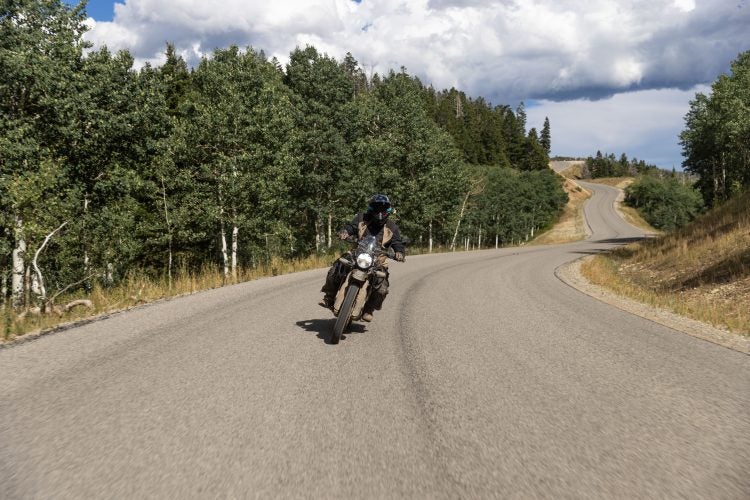
The price is fair, and the warranty is good. If I was looking to start riding a new ADV platform, I think this would be a good place to start. Photo: Royal Enfield
Final thoughts
I liked this bike a lot, and I even liked the tires—but if I was planning to ride off-pavement with this machine, I’d replace them quickly, to avoid the rapidly-heading-one-direction–then-rapidly-heading-another-direction experience. Aside from that, the little niggles can mostly be forgiven because of the price tag of $5,799 in the US, $7,699 in Canada.
At least, I think so. That price tag is in the same ballpark as the Honda CRF300 Rally, Kawasaki KLR650 and Suzuki DR650, and on paper, the Royal Enfield offers more than those machines—except years of reliability on the record. Royal Enfield’s machines and their long-term dependability are still relatively unknown to most Western buyers (although the three-year warranty will certainly ease fears).
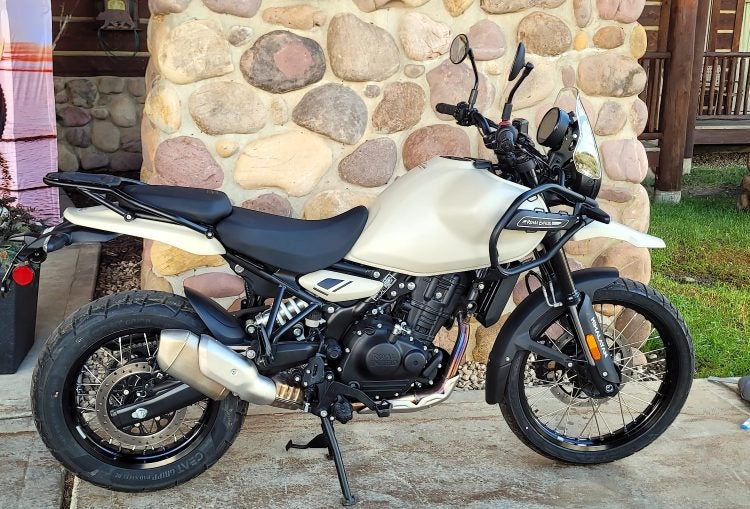
I predict this machine is going to be much more popular than the original Himalayan, and will challenge Japanese 400-650 dual sports for market share. Photo: Zac Kurylyk
I see this machine as a big test for RE, a bike that is aimed not just at at the casual buyers who want good-looking machines like cafe racers, cruisers and classics, but want—no, require—a bike with capability and reliability to handle the long haul. The first-gen Himalayan laid the groundwork, but it wasn’t quite there. If they can nail it on the second try, it’ll be a massive step forward for the brand that’s been growing like mad over the past decade.
For a look at all the colors, options and specs, not to mention pricing, US customers can look here; Aussie readers, see here; Canadian readers, see here.