
Afghanistan didn’t change much for most of the ‘70s. Chicken Street, where in 1971 I overheard the wonderful assertion by a stallholder trying to flog something to a tourist, “Of course it is a genuine antique! I made it myself!”, was still offering fake antiques and, sometimes, genuine carpets at “today only” prices in 1978. The overwhelming mix of races and cultures still brushed shoulders in the markets and everyone was more or less happily pursuing their lives according to their own tastes.
The black clouds were there on the horizon over the Bagram Valley to the north, mind you, but it was almost still possible to ignore them. Not completely; the Soviet invasion was brewing and our landlord in the old brick building overlooking Shahr-e Naw Park thought it necessary to warn Charlie and me when we told him we were heading up country to make sure people knew we were not Russian. “Otherwise,” he said, and drew his hand across his neck. In any other country that might have been an exaggeration. In Afghanistan it was a simple statement of fact.
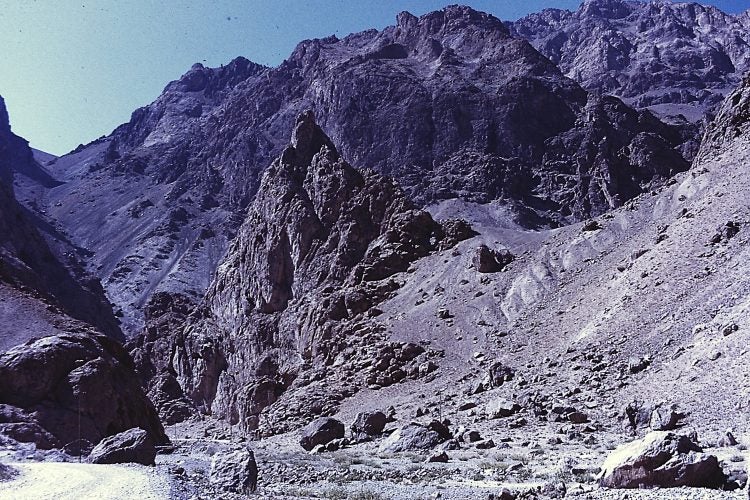
The road to Bamiyan. I almost committed involuntary suicide here while passing a truck.
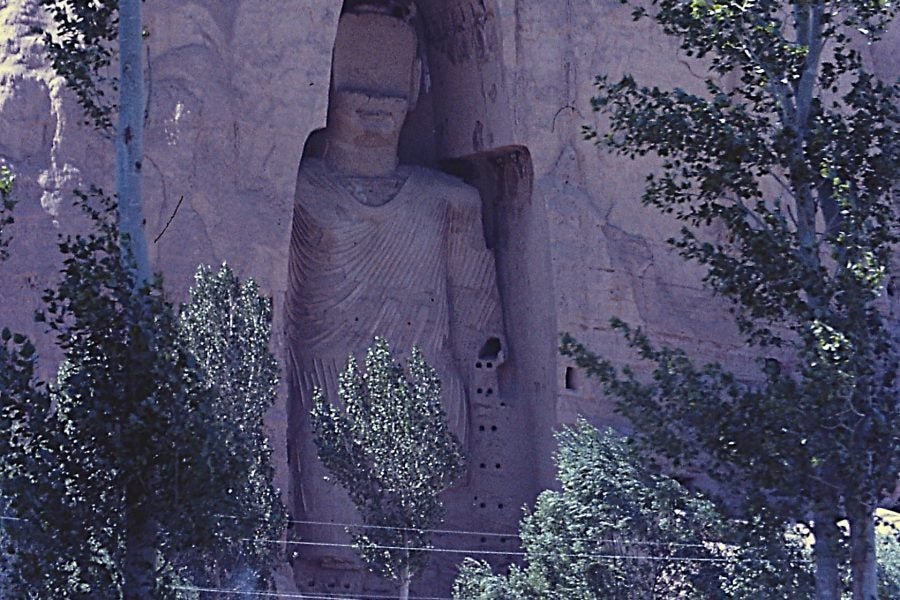
We must have succeeded in our earnest attempts to not seem Russian because we returned alive to Kabul and the big old brick building after our visit to the giant Buddhas at Bamiyan. We had our refresher shots for whatever they were for – it may have been plague – using the ampoules and syringes we had brought with us. More importantly, we had our yellow International Vaccination Cards stamped. Back then, these were as vital as passports for border crossings.
Time was running out on our visas and we took off down the American Road in the direction of Kandahar. In much of Asia, countries are judged by their (usually foreign-aid financed) road-building skills. The road down from Pokhara in Nepal to the Indian border at Sonauli, for instance, was not so much a road in a state of disintegration as a state of disintegration loosely disguised as a road. Our comments about its dire condition elicited slow head shakes. “Ah, it was built by India,” was the explanation. By contrast, the Chinese-constructed road up near Kathmandu reflected far better on its builders.
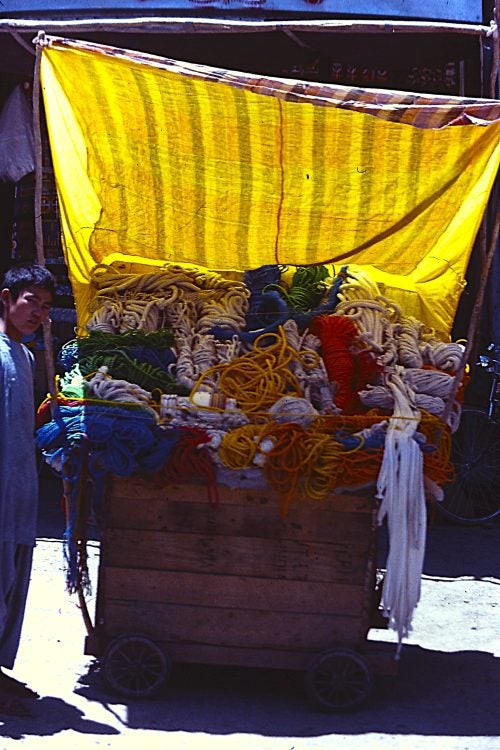
A young market vendor in Ghazni shows how to make even a stall selling bits of rope look interesting.
In Afghanistan the comparison was between the American Road linking Kabul and Kandahar and the Russian Road linking Kabul and, well, the Soviet Union in the shape of Uzbekistan, by way of Mazar-i-Sharif. I wonder if anyone in the Afghan government had considered that this was in effect a military road, an arrow aimed straight at the heart of the country. Whether they did or not, it was definitely thought to be inferior to the American effort. Having ridden both, I’m happy to support that opinion.
No matter how good the road, we were still in Afghanistan. We’d been used to kids waving to us from the roadside, but one ragged little nonconformist decided to throw rocks instead. I Take A Dim View of this behaviour, so I did a U-turn and went back to confront him. With me in pursuit he took off across the harvested roadside field as if the Shaitan himself was after him, losing both his schoolbooks and the respect of his peers who collapsed in laughter. After I’d chased him to the edge of his walled village I thought well, he won’t throw rocks at foreign motorcyclists again. Although maybe next time he’ll use an AK47. Hmm.

A short break somewhere on the American Road from Kabul to Kandahar.
For reasons I cannot remember, we spent some time looking around in Ghazni so it became clear that despite the unquestionably high quality of the road we would not be able to cover the 500km to Kandahar by nightfall. You do not ride in the dark here. It was getting that way by the time we rolled into Qalat-e Gilzay and there were either no hotels or we were unable to recognise them, so we turned to the police for advice. I wasn’t sure at the time and I am still not certain whether we were then summarily arrested because we had overstayed our visas, or hospitably welcomed to the local version of B&B with beds in the cells. The mattresses and blankets were clean and the steel door, I noted with some relief, was not locked. The bikes were stored in an enclosed and padlocked yard.
In the morning we were either fined or charged board and lodging, and waved away. Kandahar, a city of about 650,000 people, is exceptionally beautiful and known for its minarets and roses (true) but we really were running out of time so we only spent one night there. We were determined to cover the next 570km to Herat in one day – not only were we in a hurry but there didn’t seem to be any major towns promising hotels along the way. Woken by the morning call from a nearby minaret we were off with first light. Little did we know that this ride would end well past sunset after an eventful ride.
Perhaps we should have taken note of the name of the place we were about to cross: the Dasht-e Margo, or Desert of Death.
Will Charlie and The Bear survive the Desert of Death and reach Herat on their Honda XL250s? The final (but not final final, rest assured) instalment follows.
(Photos: The Bear)